You've checked ChatGPT. Your brand is there.
Gemini mentions you too. Perplexity has even included you in a few recommendations.
Not bad.
But then you look at your competitors. One of them appears almost everywhere. Another keeps getting recommended for the very customers you're trying to reach.
Suddenly, being mentioned doesn't feel like the whole achievement.
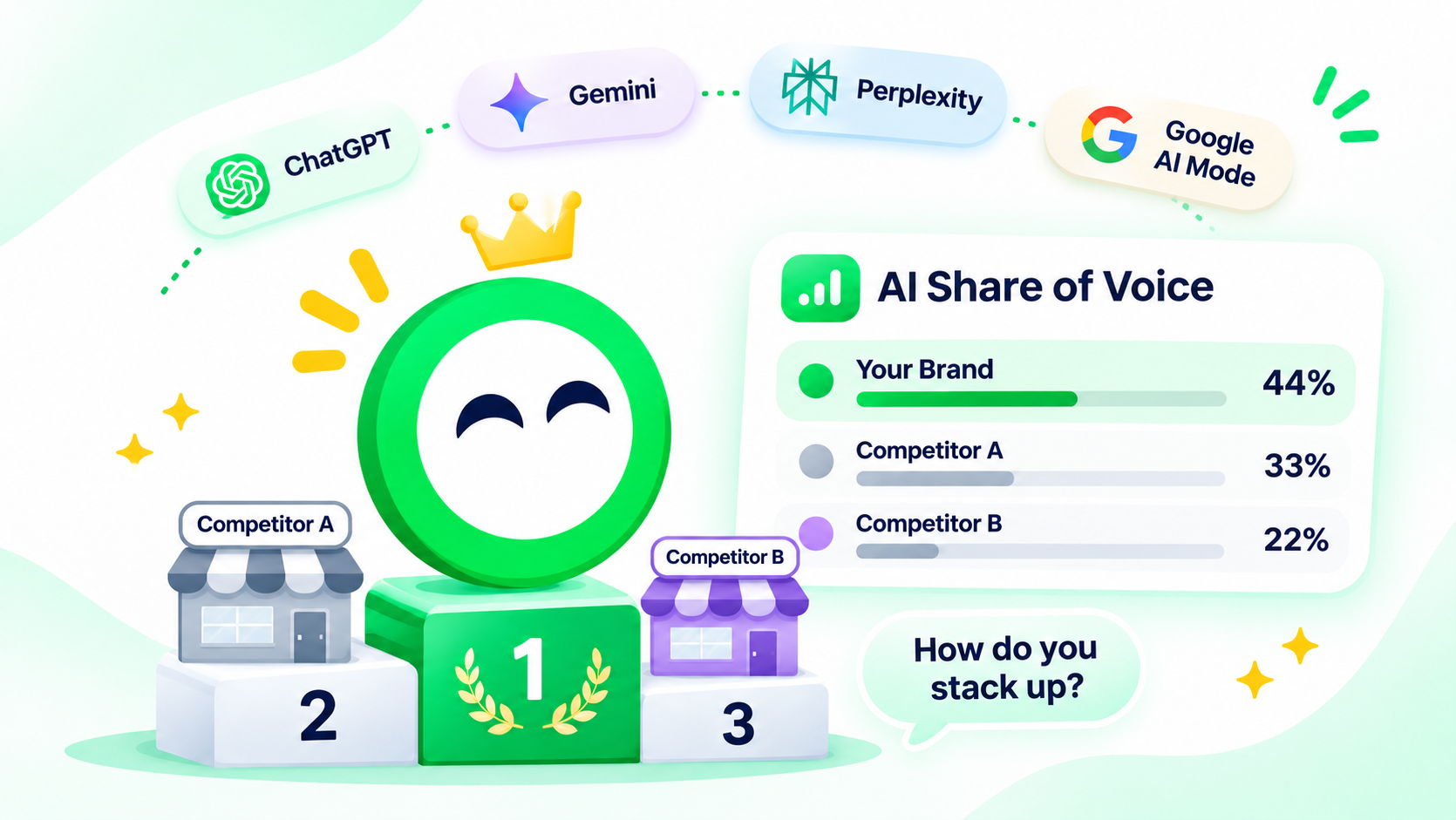
That's where AI share of voice becomes useful. It helps you understand how much visibility your brand is getting compared with competitors, rather than just counting how often your name appears.
And the interesting part isn't necessarily the percentage. It's what you discover when you start looking underneath it.
Let's work through how to calculate it, what the numbers actually mean, and how to use them to make better marketing decisions.
1. What is AI share of voice?
AI share of voice (AI SOV) measures your brand's share of visibility in AI-generated answers compared with other brands in a defined competitive set.
Think about someone asking ChatGPT:
“What's the best scheduling software for a small HVAC company?”
The response might recommend three providers. Your brand could be one of them, or it might be missing entirely.
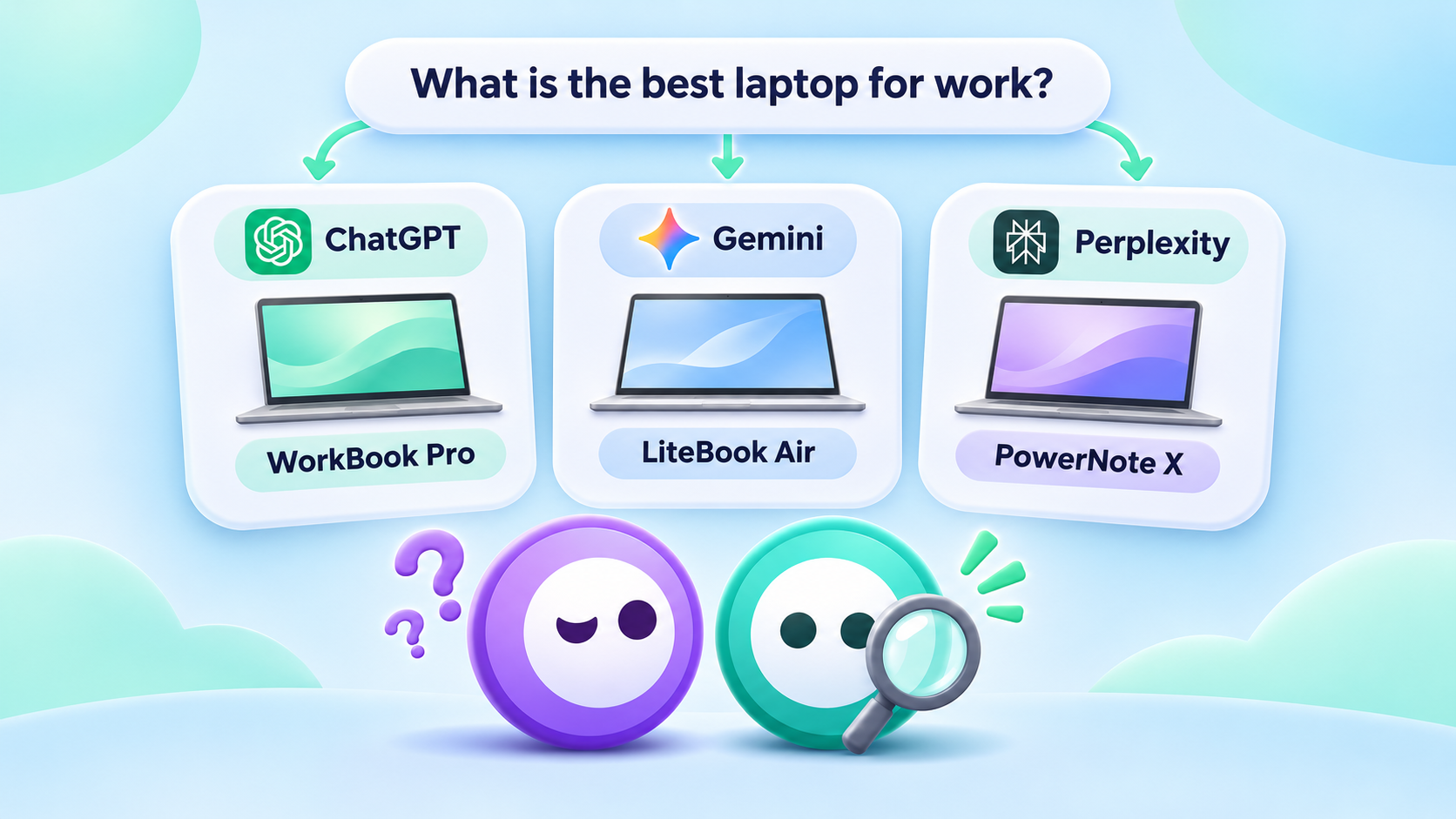
Now imagine checking that question, along with dozens of similar buyer questions, across ChatGPT, Gemini, Perplexity and other AI engines.
You'd start seeing which brands appear most often, where your competitors are getting noticed and where you're being overlooked.
AI share of voice puts that comparison into a measurable number.
But there's an important distinction to understand before we get into the maths.
AI visibility and AI share of voice aren't the same thing
Let's say you check 40 AI answers and your brand appears in 12.
Your AI visibility rate is 30%, because your brand appeared in 12 out of 40 answers.
Sounds reasonable.
But what if a competitor appeared in 24 of those same answers?
Your visibility rate tells you how often you showed up. Your share of voice tells you how much of the tracked competitive conversation belonged to you.
They're related, but they answer different questions.
It also helps to keep a few other metrics separate:
- AI visibility rate: The percentage of tracked answers that mention your brand.
- AI share of voice: Your share of brand appearances relative to a defined group of competitors.
- Recommendation rate: How often AI actively recommends your brand, rather than simply mentioning it.
- Citation rate: How often your website appears as a linked source in AI answers.
You can have a high visibility rate but a low recommendation rate. Or your website might earn citations without your brand being recommended at all.
That's why a single score can never tell the whole story.
2. How do you calculate AI share of voice?
The simplest way is to compare your brand's appearances with the combined appearances of all brands in your tracked competitive set.
For a basic calculation, use this formula:
AI Share of Voice (%) = (Your brand appearances ÷ Total appearances of all tracked brands) × 100
For consistency, count each brand only once per AI answer, even if its name appears several times.
An answer can count toward multiple brands when it mentions several competitors.
Let's make that a little more concrete.
A practical example: Three software brands competing for the same buyers
Imagine you're marketing a fictional US company that sells scheduling software for HVAC contractors.
We'll call it NorthStar Scheduling.
Two competitors, FieldFlow and ServicePilot, regularly compete for the same customers.
You select ten realistic buyer questions and check each one across four AI search experiences, giving you 40 answers.
Here's what you find:
| Brand | Answers mentioning the brand | Visibility rate | AI share of voice |
|---|---|---|---|
| NorthStar Scheduling (your brand) | 12 | 30% | 22.2% |
| FieldFlow | 24 | 60% | 44.4% |
| ServicePilot | 18 | 45% | 33.3% |
| Total brand appearances | 54 | 100% |
All brands and results are fictional and used for illustration only.
Notice that there are 54 brand appearances across 40 answers. That's possible because an individual AI answer can mention more than one brand.
For NorthStar Scheduling, the calculation is:
(12 ÷ 54) × 100 = 22.2%
Your brand appears in 30% of the answers, but accounts for only 22.2% of the tracked brand appearances.
Meanwhile, FieldFlow has almost twice your share of voice.
That gives you something worth investigating.
Is FieldFlow appearing in more discovery questions? Is it being described as a better choice for smaller businesses? Does it dominate a particular AI engine?
The percentage identifies the gap. It doesn't explain it.
One important note about AI share of voice tools
Not every platform calculates AI share of voice this way.
For example, Semrush explains a mention-based formula but also uses additional signals, including brand position, in some of its tools.
Ahrefs uses estimated impressions and weighting in its AI share of voice calculations.
So a 22% score in one tool may not be directly comparable with a 22% score in another.
That doesn't make either score useless. It means you need to understand what's being counted before interpreting the result.
For the rest of this guide, we'll use the straightforward brand-appearance method shown above.
3. Step 1: Choose competitors and buyer questions that matter
The quality of your AI share of voice data starts long before you calculate anything.
It starts with the questions you choose to track.
If you only ask AI about your own brand, you'll probably appear quite often. After all, you've put your company name in the question.
But that doesn't tell you much about what happens when buyers don't know you exist.
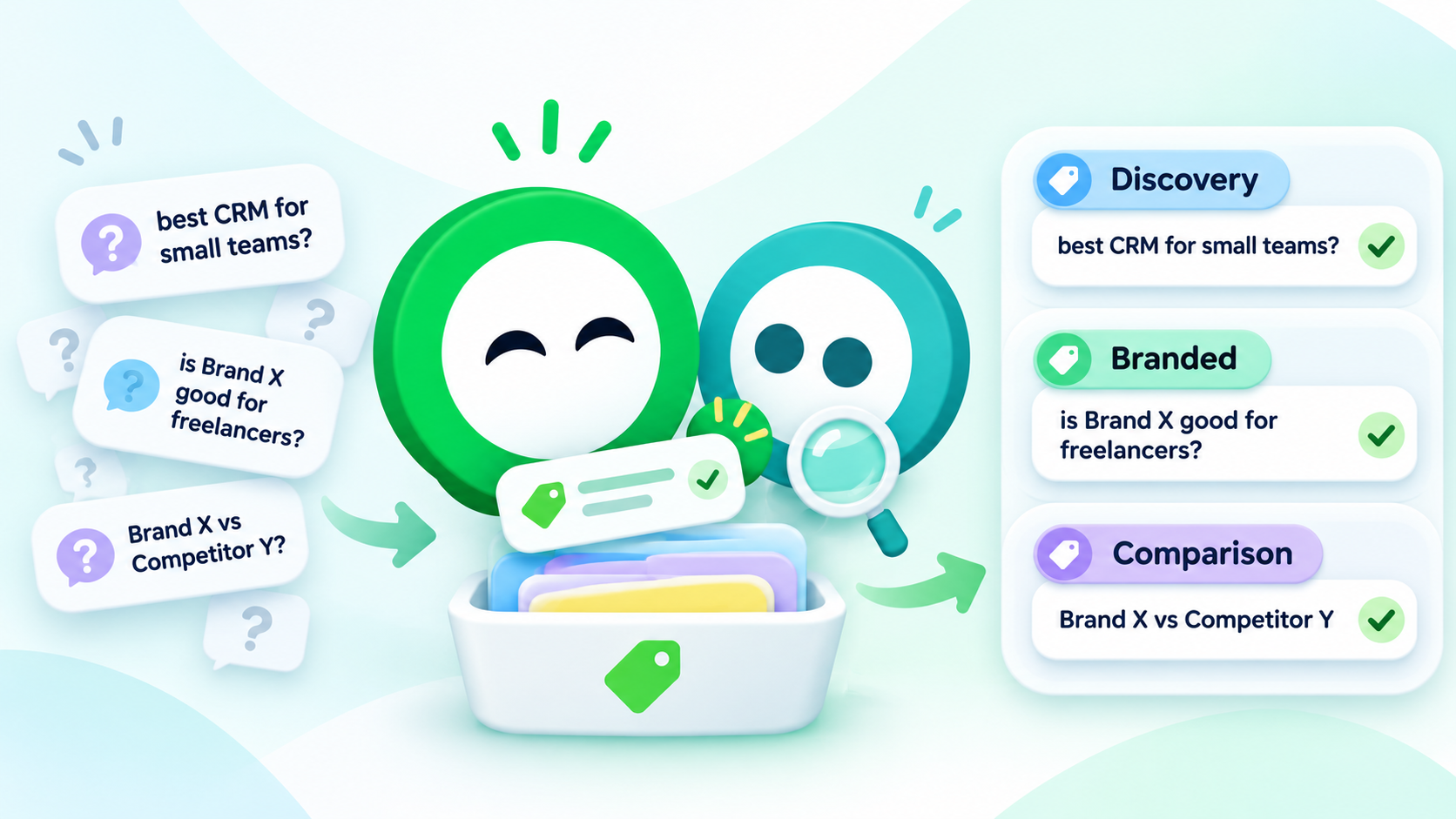
Start with realistic discovery questions
Imagine NorthStar Scheduling is trying to reach HVAC contractors in the United States.
Useful discovery prompts might include:
- What's the best scheduling software for a small HVAC business?
- Which field service management tools work well for five-person teams?
- What software helps HVAC contractors manage bookings and technician schedules?
- Which scheduling platforms are affordable for growing HVAC companies?
These questions represent situations where someone is looking for options, not necessarily for your brand.
They're particularly valuable because the answer can reveal whether you make the shortlist without being named in the prompt.
Add branded and comparison questions
Branded prompts show how AI describes your business when someone asks about it directly.
For example:
“Is NorthStar Scheduling good for small HVAC contractors?”
Comparison prompts show how AI weighs competing options.
For example:
“NorthStar Scheduling vs FieldFlow: Which is better for a five-person HVAC business?”
All three prompt types are useful, but they shouldn't be mixed carelessly.
A branded question is naturally more likely to mention your brand than an unbranded discovery question.
If you combine them without distinguishing the results, you could walk away with an inflated sense of your competitive visibility.
I'd recommend making unbranded discovery questions your primary competitive benchmark, then reviewing branded and comparison questions separately.
Don't assume you already know all your competitors
Your sales team might talk about the same three competing companies every week.
AI may have other ideas.
You might discover that ChatGPT regularly recommends a company you've barely considered, or that Perplexity keeps mentioning a specialist provider from a neighboring category.
Those are worth investigating.
AI doesn't necessarily follow the competitive boundaries you've drawn internally.
Once you've identified your competitors, keep that list consistent for reporting. If you add new companies later, record the change because it affects your share of voice calculation.
4. Step 2: Check your visibility across different AI engines
Now you've got your questions and competitors. Time to see what the AI engines actually say.
Run the same prompts across the platforms relevant to your audience.
For keenOly, those include ChatGPT, Gemini, Perplexity, Microsoft Copilot, Google AI Mode and Google AI Overviews.
Don't assume the results will match.
One engine might recommend your company for its affordability. Another might favor an established competitor. A third may not mention your brand at all.
And some experiences, particularly search features like Google AI Overviews, may not display an AI-generated response for every query.
That's an important detail to record rather than quietly treating every missing AI response as a loss for your brand.
What should you record?
A spreadsheet works perfectly well for a first attempt.
For each check, record:
- The exact buyer prompt
- AI engine and date
- Whether an eligible AI answer was returned
- Which brands appeared
- Which brand received the strongest recommendation, if any
- How your brand was described
- Any cited sources or links
You can use separate columns for each competitor, marking whether each appeared in the answer.
For the basic calculation, sum those appearances across the eligible answers and divide your brand's total by the combined appearances of all tracked brands.
Keep the exact prompts, locations, language settings and checking routine consistent wherever possible.
AI responses can vary from one run to another, so repeating checks is more useful than treating a single answer as permanent evidence.
Also, remember to report your results by engine.
Your overall score might look healthy because you perform well in ChatGPT, while Google AI Mode barely mentions you.
If you only look at the combined percentage, that difference can disappear.
5. Step 3: Find out where competitors are winning
This is where AI share of voice becomes more than a number on a report.
Let's return to NorthStar Scheduling.
Your brand has 22.2% share of voice. FieldFlow has 44.4%.
At first glance, FieldFlow is comfortably ahead.
But now you examine the actual answers.
You discover that FieldFlow appears frequently in broad questions about field service management, while NorthStar is more likely to appear when someone asks specifically about scheduling software for very small HVAC businesses.
That's a useful distinction.
Perhaps your product is positioned clearly for smaller teams, but its relevance to the wider scheduling category isn't coming through.
Or perhaps AI simply has less useful information available about your offering.
You won't know until you investigate further.
Look at how your brand is described
A mention is not necessarily a win.
Consider these two responses:
“NorthStar Scheduling is another platform businesses may consider.”
And:
“NorthStar Scheduling is a strong option for smaller HVAC teams looking for straightforward scheduling and technician management.”
Both mention the same brand.
But the second makes a much stronger case for why someone might choose it.
An AI share of voice calculation based on appearances counts both equally.
That's why it's worth examining recommendation strength, context and sentiment alongside share of voice.
You can learn more about interpreting those distinctions in our guide, Does AI Recommend Your Brand? Here's How to Find Out.
Investigate the sources behind competitor recommendations
When AI provides citations, open them.
You might discover that FieldFlow appears repeatedly in industry comparison articles, product directories or guides about HVAC business software.
Meanwhile, NorthStar is barely covered outside its own website.
That doesn't prove those sources caused AI to prefer FieldFlow.
But it does identify an information gap worth exploring.
Maybe your website doesn't explain certain use cases clearly. Maybe relevant industry publications haven't covered your product. Or perhaps your competitors have more detailed material answering the questions your customers ask.
These are all things you can investigate.
If you want to explore the citation side in more detail, our article on how to get your website cited by AI explains the practical steps.
6. Step 4: Turn your findings into marketing decisions
A share of voice report is only useful if it helps you decide what to do next.
And not every visibility gap needs the same response.
If you're missing from discovery questions
Start by examining the category language buyers use.
Does your website clearly explain what your product does, who it's for and which problems it solves?
If AI consistently recommends competitors for a particular use case, review whether your content addresses that need with enough useful detail.
This might lead to better product pages, practical guides, comparisons or clearer positioning.
If AI mentions you but rarely recommends you
Look at how the answers describe your business.
Are you consistently framed as suitable only for small companies? Does AI qualify your capabilities or describe limitations that are inaccurate or outdated?
Check your product information, relevant reviews and other public sources.
If something is wrong, correct the underlying information where you can.
If the description is accurate, perhaps the issue is that your positioning isn't as strong for that particular audience as you assumed.
That's valuable feedback too.
If competitors dominate certain AI engines
Don't automatically rewrite your entire website.
Investigate the specific prompts and sources where you're losing ground.
A competitor might be strong in Perplexity because its product appears in several relevant third-party articles. Another might perform better in ChatGPT for questions about pricing.
Treat these as different problems until you have evidence suggesting otherwise.
If your overall score is strong but important buyers are being missed
This is an easy one to overlook.
Suppose NorthStar performs well across general field service questions but rarely gets recommended for HVAC businesses with more than ten technicians.
That might be a small part of your prompt set, but perhaps those companies represent your most valuable potential customers.
A good overall score could hide a commercially important weakness.
That's why not every prompt should carry equal weight in your business decisions, even if your baseline share of voice calculation treats them equally.
You can group prompts by buyer type, product category or purchase intent, then prioritize the ones that matter most.
If you decide to create a weighted share of voice metric, document those weights and keep them consistent between reporting periods.
Otherwise, you risk changing the measurement every time you want the number to look better.
7. Step 5: Track changes, not just today's score
An AI share of voice report gives you a snapshot.
Useful, but limited.
AI answers change. Competitors update their websites. New reviews appear. Product information gets refreshed. The same question can produce a different answer next month.
So, how often should you check?
For many marketing teams, weekly or monthly tracking is a sensible starting point.
The right frequency depends on how quickly your market changes and how important AI discovery is to your business.
What matters most is consistency.
Keep your prompt set stable, record the engines you checked, and compare results using the same calculation.
Then pay attention to changes such as:
- Your share of voice increasing in important discovery prompts
- A competitor becoming more prominent in a particular category
- Your brand appearing more often but receiving weaker recommendations
- New competitors entering the answers
- Different sources becoming prominent alongside competitor mentions
A rising share of voice is encouraging. But it's not proof that a particular content update caused the improvement.
Look for repeated patterns before drawing conclusions.
And remember that AI visibility isn't the same as website traffic or conversions.
A brand can receive more recommendations without generating an immediate click. If you want to understand what happens once visitors reach your site, our guide to tracking AI traffic in Google Analytics 4 covers that side of the story.
Where Oly fits in
You can begin measuring AI share of voice manually.
But as your prompt set grows, checking multiple engines, comparing brands and reviewing answers becomes a lot of work.
Oly helps you keep an eye on the questions buyers are asking, the brands that appear, the competitors getting recommended and the sources showing up in AI answers.
Instead of piecing together screenshots from different engines, you can investigate your competitive visibility in one place.
Oly doesn't make the marketing decisions for you.
Oly helps you find the details you might otherwise miss. 💚
8. Common AI share of voice mistakes to avoid
Before you start celebrating a rising score, make sure you're measuring the right thing.
1. Relying too heavily on branded prompts
If your questions already contain your company name, your visibility rate is likely to look stronger. Keep branded, discovery and comparison prompts separate.
2. Treating every mention as a recommendation
An AI engine can name your brand and still strongly favor a competitor. Record recommendation strength alongside appearances.
3. Changing competitors between reports
Adding or removing a competitor changes the denominator of your share of voice calculation. Document any changes to your competitive set.
4. Comparing scores from different tools without checking their methodology
Some platforms use mentions, while others incorporate estimated impressions, position or weighting. Their percentages aren't automatically interchangeable.
5. Ignoring the differences between AI engines
Strong performance in one platform can hide weak visibility in another. Compare results per engine before relying on an overall figure.
6. Treating every prompt as equally valuable
A prompt from a buyer actively choosing software may matter more commercially than a broad informational question. Use audience and intent segments to guide priorities.
7. Drawing conclusions from one round of answers
AI responses can vary. Repeat your checks, look for consistent patterns and avoid treating a single result as a permanent ranking.
One final point: there's no universal percentage that makes your AI share of voice "good."
A 30% share might be encouraging in a crowded category with many strong competitors. It might be disappointing in a market where you expect to dominate.
The number needs context.
The real question isn't just how often you appear
It's tempting to chase a higher AI share of voice score.
And yes, increasing your presence in relevant AI answers can be a worthwhile goal.
But appearing more often isn't necessarily the same as becoming more relevant to the people you want to reach.
Your brand could dominate broad questions while barely appearing when buyers compare solutions.
You might be mentioned frequently but rarely recommended.
Or you could have a smaller overall share of voice while performing particularly well among your most valuable customers.
That's why the best AI visibility analysis doesn't stop at the percentage.
It looks at who's asking, what they're asking, which brands are being recommended and where the opportunities are.
Your share of voice tells you how much of the tracked conversation you're getting.
The answers underneath tell you what might deserve your attention next.
And if you're curious about who's winning those conversations while you're not looking?
Oly would be keen to find out.
Start with 10 free ChatGPT prompts and 10 questions to Oly. Find out where your brand appears, which competitors show up instead and what deserves a closer look.