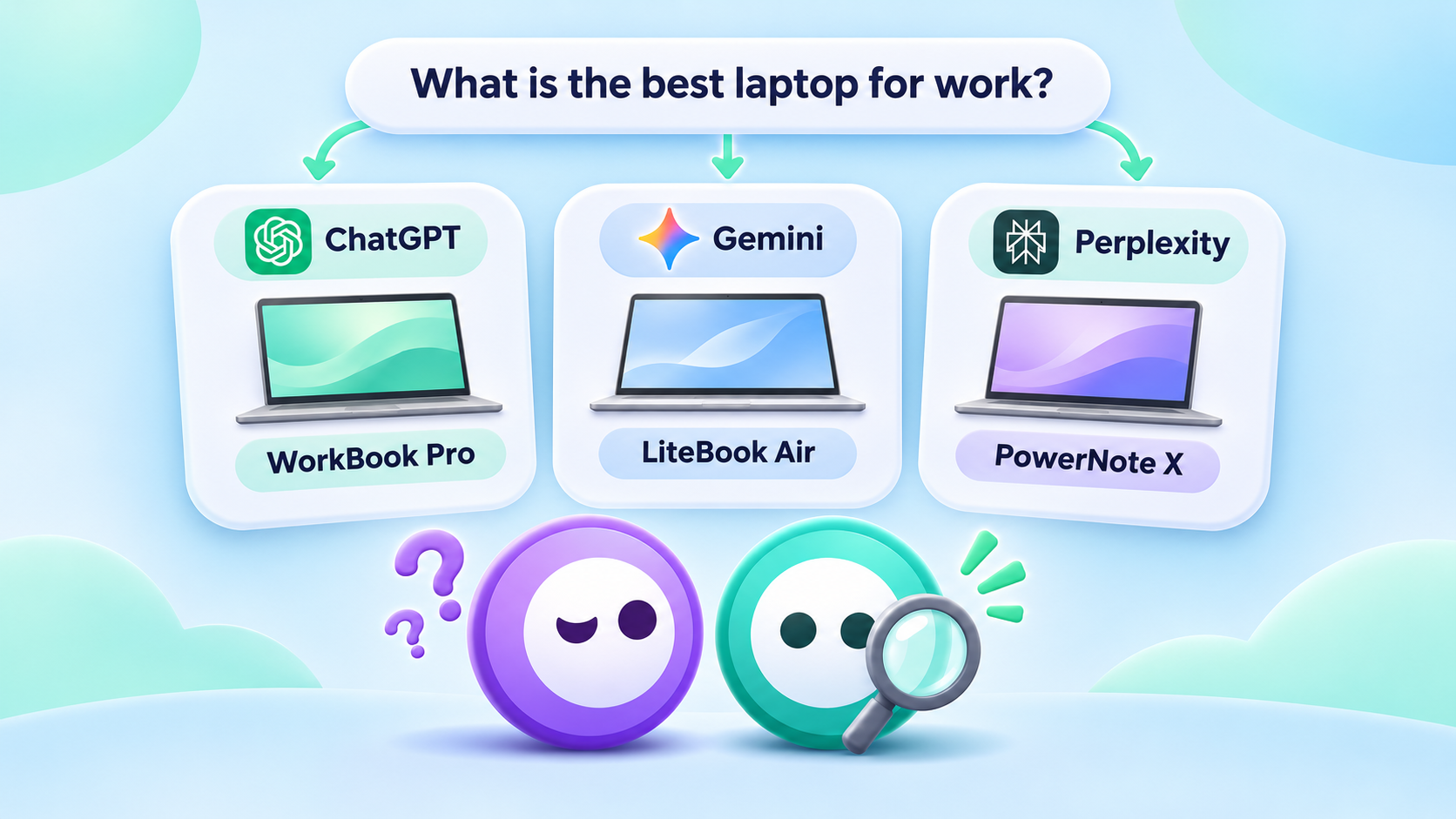
Just because ChatGPT likes you doesn't mean Gemini feels the same way.
And Perplexity? Well, it might have someone else in mind entirely.
In September 2026, research from Searchable examined 38,966 unbranded questions submitted to both ChatGPT and Gemini. Under the study's methodology, the brands the two platforms consistently recommended had just 42% overlap.
That's a rather interesting problem for marketers.
We've spent years trying to understand how our brands perform on Google. Now we're dealing with multiple AI engines, each capable of producing a different shortlist of businesses, interpreting our strengths differently and finding reasons to recommend our competitors.
So when someone tells you that your brand has good AI visibility, Oly has a little follow-up question.
On which engine? 👀
Why do different AI engines give different answers?
AI search engines give different answers because they use different models, information retrieval systems, search techniques and approaches to interpreting questions. Their responses can also be influenced by location, conversation history, personalization and the information available at the time of the search.
There isn't one universal AI ranking system that determines which brands appear everywhere.
Here are some of the reasons the engines disagree.
They don't necessarily read the same sources
Two AI engines can search the web for the same information and retrieve substantially different sets of pages.
One might find a detailed product comparison from an industry publication. Another might retrieve manufacturer websites, customer reviews or community discussions.
Even when they encounter the same sources, they may draw different conclusions from them.
That matters because the evidence an engine finds can influence which brands it recommends and how it describes them.
They interpret buyer questions differently
Take a question such as:
"What are the best accounting software options for a small business in the US?"
What does "best" actually mean?
Lowest price? Ease of use? Payroll integration? Something your accountant already knows how to use?
Unless the buyer specifies those requirements, the AI engine has to decide which factors are worth considering.
Different interpretations can produce different recommendations, even when the underlying product information is accurate.
One question can turn into several searches
AI engines don't always search the web using the exact words someone types.
Google explains in its AI search documentation that AI Mode and AI Overviews may use a technique called query fan-out, issuing multiple related searches to gather information across different aspects of a question.
An accounting software question, for instance, could lead to related searches about pricing, payroll integration, customer reviews and software for specific industries.
Those searches are illustrative, but they demonstrate how an apparently simple question can become a much broader research exercise.
Your brand might be visible for the original topic but missing from the sources covering those more specific requirements.
They bring different existing knowledge to the conversation
AI models are trained differently and may have different prior knowledge about brands, products and industries.
Some answers draw heavily on information retrieved from the web. Others may incorporate more of the model's existing knowledge.
This is one reason a brand can appear in an answer without its website being cited.
It's also why improving AI visibility involves more than getting a few additional website links into generated responses.
How six major AI search engines differ
There are important differences between AI search platforms, including those operated by the same company.
Here's a closer look at the six AI search experiences keenOly monitors.
| AI engine | How it works | What brands should investigate |
|---|---|---|
| ChatGPT | Conversational AI that can search the web and incorporate relevant user context. | Brand recommendations, descriptions, citations, advertisements and product placements. |
| Google Gemini | An AI assistant that can use Google's information ecosystem and provide supporting sources when available. | Brand perception, recommendation frequency and related sources. |
| Perplexity | A search-oriented answer engine with an emphasis on responses supported by citations. | Cited websites, third-party coverage and competitor recommendations. |
| Google AI Overviews | Generated summaries displayed within Google Search when appropriate. | Whether your brand and website appear within AI summaries alongside traditional search results. |
| Google AI Mode | A dedicated conversational search experience that can investigate multiple aspects of a question. | Visibility across detailed buyer questions, related searches and supporting content. |
| Bing AI Mode | AI-powered search grounded in Microsoft's web search and information retrieval systems. | Brand visibility, Bing indexing, citations and competitive appearances. |
These are descriptions of documented platform capabilities, not a breakdown of proprietary ranking algorithms.
And here's something particularly interesting: even Google's own AI products don't necessarily agree with each other.
Google acknowledges that AI Mode and AI Overviews can use different models and methods, leading to different answers and supporting links.
Being visible in one doesn't automatically mean you're visible in the other.
Same question, different AI engines: A real example
How big can these differences actually be?
Quite big, apparently.
In September 2026, Petra Labs published research examining recommendation patterns across five AI systems and four industries.
Among the questions tested were recommendations for secured credit cards.
Look at how two established financial brands performed.
| Brand | AI engine | Percentage of answers mentioning the brand |
|---|---|---|
| Discover | Google AI Overviews | 99.6% |
| Discover | Google Gemini | 20.3% |
| Bank of America | ChatGPT | 98.2% |
| Bank of America | Google AI Overviews | 3.4% |
These figures represent brand appearances within the study's specific tests, not market share or the percentage of actual customers receiving those recommendations.
Still, the differences are remarkable.
If Discover had assessed its AI visibility using Google AI Overviews alone, the results would have looked considerably more reassuring than its performance on Gemini.
And both are Google products.
Similarly, Bank of America's strong performance on ChatGPT wouldn't have revealed its much lower visibility in AI Overviews.
For a marketing team, those aren't merely interesting differences in a report. They represent very different discovery opportunities that deserve investigation.
Why does the same AI engine give different answers every time?
As if six engines disagreeing weren't enough, sometimes an engine disagrees with itself.
Ask ChatGPT the same question twice, and you may receive different recommendations, different citations or a different order of brands.
That can happen for several reasons:
- Variation in how the AI generates its response.
- Changes in the web pages retrieved for an answer.
- Model and search system updates.
- Location, language and personalization.
- Previous messages within the conversation.
- Changes in product availability, pricing or other information.
OpenAI's search documentation also explains how location and relevant remembered information can influence web searches.
This makes checking your brand through your own ChatGPT account a useful experiment, but not necessarily a representative measurement of what new customers encounter.
After all, you've probably told ChatGPT quite a bit about your business already.
A prospective customer hasn't.
The solution isn't to find one definitive AI answer. It's to observe enough relevant answers to understand the patterns.
The problem with a single AI visibility score
Averages have a rather unfortunate habit of making everything look fine.
Consider the following example of a fictional outdoor footwear brand tracking the same 50 discovery prompts across six AI engines.
| AI engine | Answers mentioning the brand | Discovery visibility |
|---|---|---|
| ChatGPT | 36 of 50 | 72% |
| Google Gemini | 8 of 50 | 16% |
| Perplexity | 22 of 50 | 44% |
| Google AI Overviews | 30 of 50 | 60% |
| Google AI Mode | 12 of 50 | 24% |
| Bing AI Mode | 18 of 50 | 36% |
| Combined | 126 of 300 | 42% |
Illustrative data only. These are not actual keenOly scan results.
A combined visibility score of 42% doesn't sound particularly alarming.
But look a little closer.
The brand appears frequently in ChatGPT responses, yet struggles to make an appearance in Gemini. It's also considerably more visible in Google AI Overviews than in Google AI Mode.
If the marketing team only saw the combined number, it might miss both problems.
And knowing that visibility is low doesn't tell the team whether the problem involves weak category discovery, negative brand perception or competitors being recommended more often.
Those deserve separate measurements, too.
That's why keenOly keeps Discovery Visibility, Branded Perception and Competitive Win Rate distinct, alongside individual engine leaderboards.
An average can be useful for summarizing performance. It just shouldn't become a hiding place for the interesting bits.
Do you need a different GEO strategy for every AI engine?
Not entirely. And your marketing team will probably be relieved to hear that.
Many of the principles behind good Generative Engine Optimization (GEO) and Answer Engine Optimization (AEO) apply across platforms.
Accurate product information, useful content, accessible websites, credible third-party coverage and consistent brand details are sensible foundations regardless of which AI engine you're targeting.
What should differ is where you concentrate your efforts.
Suppose your software is frequently recommended in ChatGPT, but rarely appears in Perplexity.
Before rewriting your entire website, investigate the sources Perplexity is citing for those particular questions.
Are they comparison websites that don't include your product? Independent reviews discussing features you haven't explained clearly? Industry publications covering your competitors?
Alternatively, poor visibility in Google AI Overviews might prompt you to investigate whether relevant pages are indexed and easily discoverable through Google Search.
These are investigative starting points, not guaranteed explanations for missing recommendations.
Google's guide to optimizing for generative AI search features reinforces the importance of established SEO foundations and original, useful content.
Rather than building six completely separate GEO strategies, build one strong foundation and refine your priorities according to the gaps each engine reveals.
How to track your brand across multiple AI search engines
You can begin with a fairly straightforward process.
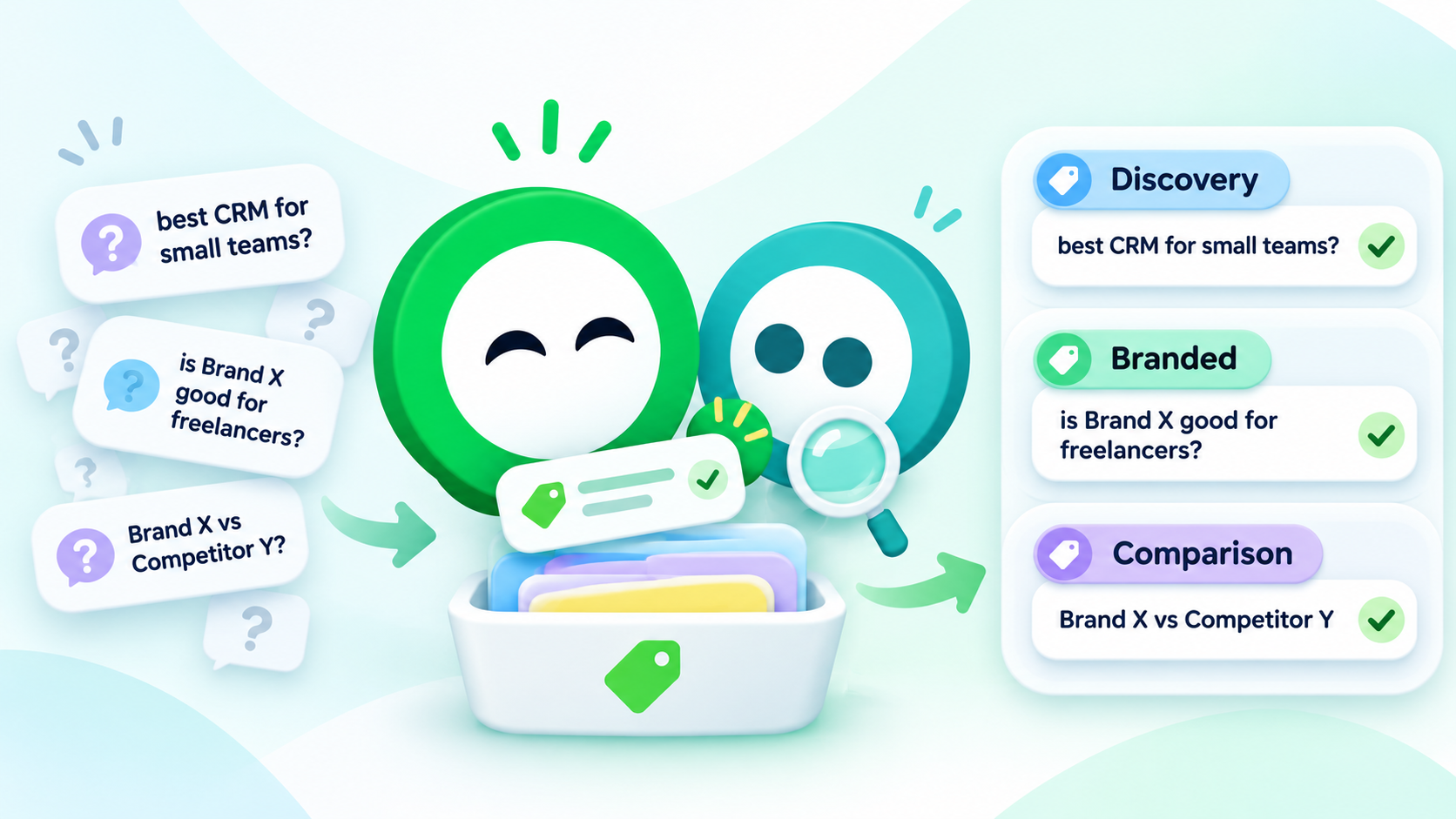
1. Choose meaningful buyer questions
Select prompts that reflect real customer needs, purchase considerations and comparisons.
Keep discovery questions separate from those that explicitly name your brand or competitors.
If you're not sure where to start, our guide to choosing which AI search prompts to track can help you build your initial list.
2. Run the same prompts across different engines
Keep your questions, target country and language consistent wherever possible.
Record the date, search settings and other relevant test conditions so you can make meaningful comparisons.
If an engine doesn't generate an answer, record that separately rather than treating it as proof that your brand was excluded from a recommendation.
3. Compare more than brand mentions
Look at what each engine actually says.
Does it recommend your brand or simply mention it? Which competitors appear? How is your product described? What reasons does the engine give for choosing one brand over another?
Two engines might mention your business equally often while expressing quite different opinions about it.
4. Investigate the sources behind the answers
Look for websites that repeatedly appear in competitor recommendations but rarely feature your brand.
Also examine whether the engines are retrieving different pages from your own website.
These differences can help identify content gaps, outdated information and opportunities to strengthen third-party coverage.
Our guide to getting your website cited by AI explores this in more detail.
5. Monitor changes over time
Keep your core prompt list consistent and repeat the checks regularly.
Look for persistent gaps rather than reacting to every individual answer.
When a competitor repeatedly appears ahead of your brand on the same engine, across several commercially relevant questions, you've probably found something worth spending time on.
Why Oly doesn't play favorites
Some engines might be rather fond of your brand. Others might need a little convincing.
Oly is interested in all of them.
With keenOly, you can monitor six AI search engines, inspect individual responses and compare separate engine leaderboards without having to open six browser tabs and maintain an increasingly complicated spreadsheet.
You can investigate where competitors are winning, which sources are repeatedly cited and what related searches the engines performed while generating their answers.
And when you discover a visibility gap, Agent Oly can help identify content and citation opportunities, develop improvements and implement approved fixes through supported CMS workflows.
Because finding out that Gemini keeps recommending someone else is only useful if you have a way to investigate what to do about it.
Your brand has more than one AI story
The next time you check your brand's visibility in ChatGPT and feel rather pleased with the answer, enjoy the moment.
Then ask another engine.
You might find a completely different set of competitors, a surprising description of your business or a source you hadn't considered important.
None of that necessarily means your entire marketing strategy needs replacing. It might simply mean there's a part of your brand's AI story you haven't been paying attention to.
And that's exactly the sort of thing Oly is keen to know. 💚
Start with 10 free ChatGPT prompts and 10 questions to Oly. Explore all six AI engines with a paid plan when you're ready to investigate the bigger picture.
Frequently asked questions
Do ChatGPT, Gemini and Perplexity recommend the same brands?
Not always. The three platforms can retrieve different sources, interpret buyer questions differently and generate different recommendations. A brand's visibility on one platform doesn't guarantee similar visibility on another.
Why is my brand visible on ChatGPT but not Gemini?
Possible reasons include differences in source retrieval, existing model knowledge, question interpretation and the information available about your brand. Comparing the answers, related searches and cited sources can help identify potential visibility gaps.
Are Google Gemini, AI Mode and AI Overviews the same?
No. They are distinct AI search and assistant experiences within Google's ecosystem. They can use different models, techniques and information retrieval processes, resulting in different answers and sources.
Does ranking first on Google help my brand appear in AI answers?
Strong Google rankings and sound SEO practices can support discoverability, particularly within Google's AI search features. However, ranking first does not guarantee a citation or recommendation from any AI engine.
Which AI search engine should my business prioritize?
Prioritize the platforms most relevant to your target audience and commercial objectives. Monitoring multiple engines helps you identify where your brand has the strongest presence and where meaningful opportunities for improvement exist.
How can I monitor my brand across multiple AI search engines?
Platforms such as keenOly allow you to track representative buyer questions across multiple engines, compare brand recommendations, investigate competitors and sources, and monitor changes over time.