โ† Blog

6 Best AI Visibility Monitoring Tools for Brands and Agencies in 2026

Not all AI visibility tools are built to do the same job. Compare six leading GEO platforms, their pricing, features and automation capabilities, and discover which tools help brands and agencies go beyond monitoring and turn AI search intelligence into action.

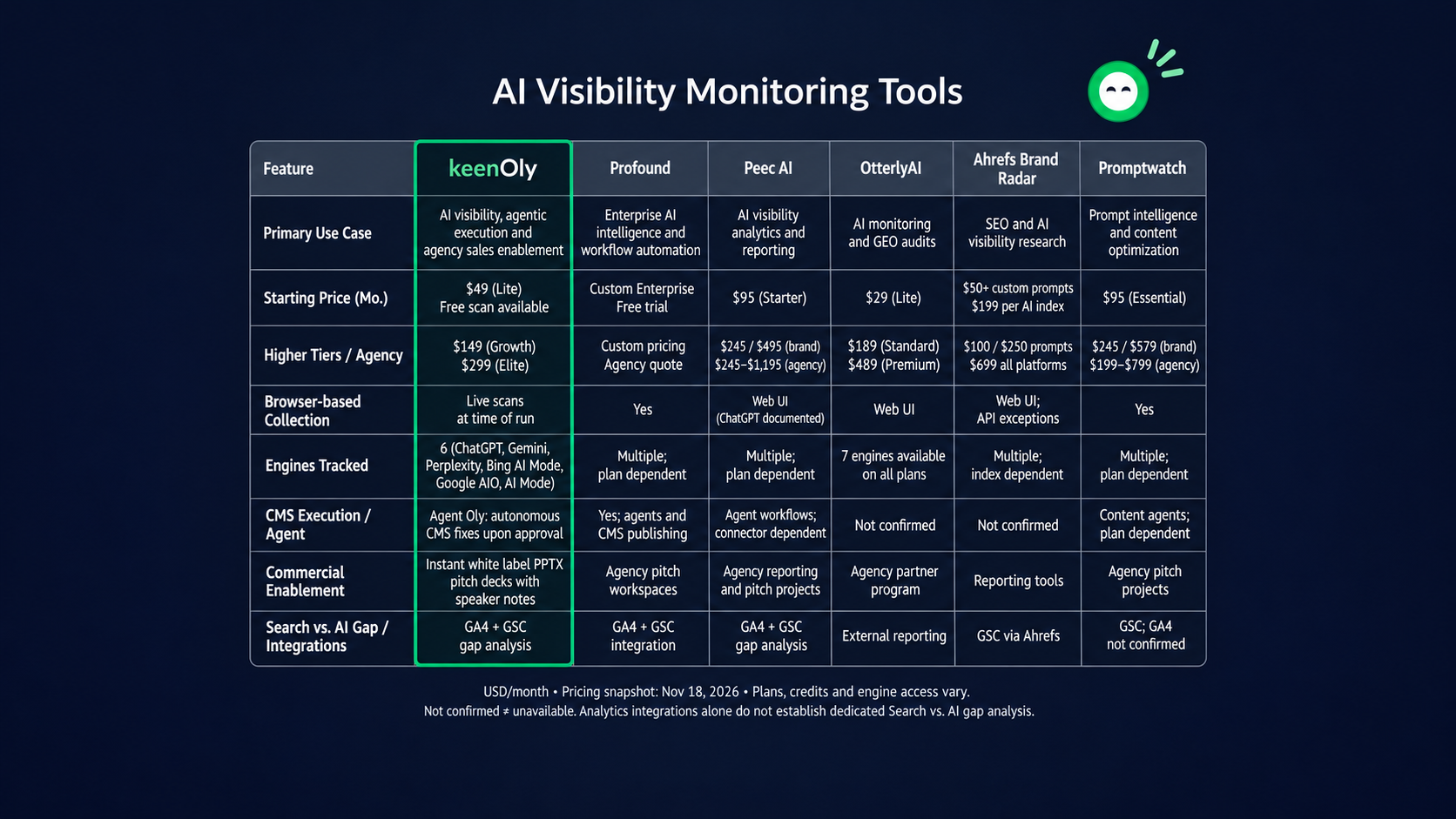
Comparison of six AI visibility monitoring tools in 2026: keenOly, Profound, Peec AI, OtterlyAI, Ahrefs Brand Radar and Promptwatch, covering pricing, AI engines, CMS automation, agency features and analytics integrations.

Ranking first on Google used to be a pretty good reason to celebrate.

It still is. But there are now buying conversations happening elsewhere, and your SEO reports might not be telling you much about them.

In September 2026, NielsenIQ reported that 51% of US consumers had used AI to assist with shopping in the previous month.

People are asking ChatGPT, Gemini and Perplexity which products to buy, which companies to work with and which brands to trust. And unlike a traditional search results page, an AI answer can narrow the options down to a handful of recommendations.

Lovely if you're one of them. Less lovely if you're not.

For brands, this creates a competitive blind spot: missed recommendations can mean missed commercial opportunities, even while search rankings look healthy. For agencies, it introduces another challenge: how do you demonstrate value, protect client retainers and grow new GEO services when traditional SEO metrics no longer tell the whole story?

It's one reason Generative Engine Optimization (GEO) and Answer Engine Optimization (AEO) are becoming increasingly important parts of digital marketing.

We've compared six of the best AI visibility monitoring tools in 2026, looking at how they collect data, what they measure, how much they cost and, perhaps most importantly, what they help you do next. Our starting point is simple: a GEO platform should help you see more, do more and, if you're an agency, sell more.

Because Oly has never been particularly satisfied with knowing there's a problem and leaving it at that. ๐Ÿ’š

What are AI visibility monitoring tools?

AI visibility monitoring tools measure how often, where and in what context brands appear in AI-generated answers across platforms such as ChatGPT, Gemini, Perplexity and Google AI search.

Depending on the platform, they can help you monitor:

  • Brand mentions and recommendations

  • AI share of voice and competitor performance

  • Brand sentiment and perception

  • Sources and citations influencing AI answers

  • AI search prompts and related queries

  • Advertising and product recommendations

  • Website traffic originating from AI platforms

  • Content and technical optimization opportunities

Traditional SEO tools remain valuable. In fact, Google introduced dedicated generative AI performance reports in Search Console in June 2026.

But knowing how your website performs in Google doesn't necessarily tell you which competitors ChatGPT recommends or why Gemini keeps citing someone else's content.

A growing number of GEO platforms are also moving beyond measurement, introducing AI agents that help investigate problems, create content and implement improvements.

That distinction between monitoring and execution is worth paying attention to when choosing a platform.

The 6 best AI visibility monitoring tools in 2026: At a glance

PlatformPrimary strengthBest suited to
keenOlyAI visibility, agentic execution and agency sales enablementBrands and agencies looking to turn insights into action
ProfoundEnterprise AI intelligence and workflow automationLarge marketing and content operations teams
Peec AIAccessible AI visibility analyticsMarketers who prioritize clear reporting
OtterlyAIAI search monitoring and GEO auditsBusinesses establishing a GEO strategy
Ahrefs Brand RadarLarge-scale SEO and AI visibility researchEstablished SEO teams
PromptwatchGranular prompt analysis and content optimizationSpecialist GEO teams

If you want to see live AI search experiences, connect competitive visibility with search and traffic data, let an agent implement approved CMS fixes and generate white label client pitches, we'd start with keenOly. Its paid plans begin at $49 a month and include access to all six engines, GA4, Search Console, Oly and executive briefing decks, subject to plan allowances. You can also try a free scan before paying.

But different teams have different priorities, so let's look at where each platform fits.

Editorial disclosure: This comparison is published by keenOly, which is one of the platforms featured. Competitor assessments are based on publicly available product information and our interpretation of each platform's positioning as of November 18, 2026, rather than independent hands-on testing of all six products. keenOly's capabilities are described using our own product information. Features and availability may vary by subscription. Prices are in US dollars on monthly billing unless noted.

1. Profound: Best for enterprise AI visibility intelligence

Profound has established itself as a prominent enterprise-focused AI search intelligence platform.

It's designed for marketing teams that need to understand brand perception at scale, analyze large amounts of AI visibility data and bring those findings into broader marketing operations.

Pros

  • Enterprise-scale brand sentiment and competitive intelligence.

  • Detailed analysis of AI mentions, citations and recommendations.

  • Data exports and automated workflows suitable for large research and content operations.

  • Browser-based AI answer collection.

  • Google Analytics 4 and Google Search Console integrations, including page-level search performance and AI citation comparisons.

  • AI agents that can generate content and publish it through connected CMS platforms.

Profound's Agents extend its capabilities beyond reporting, allowing teams to build workflows around their visibility data.

Limitations

Profound's extensive workflow capabilities may require more configuration and operational planning than a smaller marketing team wants to undertake.

Profound captures answers from the consumer web interface, not simply from model APIs. Its breadth is an advantage; buyers should still check which engines, visual answer elements and workflows are available on their chosen plan. (data methodology).

Profound offers ChatGPT shopping intelligence on Enterprise and advertising integrations, including OpenAI Ads performance data. However, buyers should distinguish between accessing their own advertising campaign data and observing which competitor ads actually appear alongside specific AI answers. (OpenAI Ads integration).

It's also worth asking how quickly newly introduced interface features and visual recommendations become available for monitoring.

Our assessment: Profound deserves consideration for enterprise teams with extensive intelligence requirements and the resources to build sophisticated marketing workflows. Its latest advertised brand offering is a free trial followed by custom Enterprise pricing, so teams that prefer a transparent starting subscription should compare alternatives. (pricing).

2. Peec AI: Best for accessible AI visibility reporting

Peec AI makes AI search performance relatively easy to understand, particularly for marketing teams that don't want to spend their afternoons explaining complicated dashboards.

Its approach centers on visibility, sentiment, position, share of voice and the sources influencing AI recommendations.

Pros

  • An accessible, visually intuitive reporting experience.

  • Competitive AI share of voice benchmarking.

  • Brand sentiment and position tracking.

  • Source analysis and content improvement recommendations.

  • Google Analytics 4 and Google Search Console integrations, including page-level Google search versus AI citation gap analysis.

  • Agency reporting and pitch projects for prospective clients.

Peec AI has also introduced Peec Agent and Actions, expanding its offering into connected marketing workflows and content publishing.

Limitations

Although Peec AI has moved beyond passive reporting, the extent of automation depends on which integrations are connected and what actions those integrations support.

For teams seeking an end-to-end GEO execution process, it's worth examining how much work happens within the platform and how much still requires coordination across external systems.

Its analytics integrations also help identify pages that rank in Google but are rarely cited by AI, and vice versa. That provides useful commercial context, but no platform can conclusively attribute every lost purchase to a competitor's AI recommendation.

Our assessment: Peec AI is a strong option if accessible reporting and stakeholder communication are priorities. Teams looking for extensive remediation and agency sales workflows should compare those capabilities separately.

3. OtterlyAI: Best for AI search monitoring and GEO audits

OtterlyAI is particularly relevant for businesses beginning to establish their AI search performance baseline.

It gives marketing teams a practical way to monitor AI answers, assess website readiness and uncover opportunities for improvement.

Pros

  • Seven AI search platforms available on all plans, including ChatGPT, Perplexity and Google AI Overviews. Engine selection and usage are subject to workspace and credit allowances.

  • Automated GEO audits covering technical and content issues.

  • Content briefs and optimization recommendations.

  • ChatGPT advertising and shopping tracking on all plans.

  • AI crawler and visitor analytics.

Its GEO features make it useful for initial research, website audits and conversations with clients who are new to AI search optimization.

Limitations

Identifying a content or technical issue isn't necessarily the same as resolving it.

OtterlyAI offers optimization guidance and content briefs, but buyers seeking autonomous, approval-based CMS remediation should investigate how far its current implementation capabilities extend.

It collects responses through public AI web interfaces and offers analytics and external reporting integrations, including Looker Studio, where AI visibility data can be combined with traditional search and website analytics. (collection methodology).

For agencies, the question is how easily those datasets can be connected to identify individual pages that perform well in Google but remain absent from commercially important AI answers. Its credit-based engine allowances are also worth checking when planning coverage across all seven platforms.

Our assessment: OtterlyAI is a useful choice for monitoring, GEO audits and establishing a baseline before committing to a wider optimization program.

4. Ahrefs Brand Radar: Best for established SEO teams

Ahrefs Brand Radar brings AI visibility research into one of the most established SEO ecosystems.

For teams already using Ahrefs for keyword research, backlinks and competitive intelligence, that familiarity is a considerable advantage.

Pros

  • A large database of search-backed AI prompts.

  • AI visibility research across multiple platforms, including Google AI Overviews and AI Mode.

  • Brand mentions, citations, sentiment and share of voice.

  • Custom conversational prompt tracking.

  • Related search query analysis and broader online brand research.

Ahrefs explains its approach in its Brand Radar methodology, which combines search behavior with broader topic coverage.

Limitations

Ahrefs' historical search data is one of its greatest strengths, but conventional keyword demand and conversational AI intent aren't necessarily the same thing.

A keyword such as "best running shoes" doesn't capture the specific requirements of someone asking ChatGPT for affordable running shoes suitable for wide feet and marathon training.

Ahrefs addresses this through custom prompts, although teams still need to decide which questions represent their most commercially important buyers.

Brand Radar's principal strength is research and analysis. Its indexed chatbot answers are collected through web interfaces, with some exceptions, and historical indexes refresh separately from custom prompt checks. Businesses wanting an agent to investigate a specific citation gap and implement an approved content change should evaluate the wider Ahrefs execution workflows separately. (Brand Radar documentation).

Our assessment: Ahrefs Brand Radar makes particular sense for SEO teams that want to expand their existing research capabilities into AI visibility.

5. Promptwatch: Best for granular AI prompt and content analysis

Promptwatch takes a detailed approach to understanding AI answers, the sources behind them and the content opportunities they reveal.

It's useful for businesses that want to examine specific questions closely, particularly where technical requirements or subtle differences in AI responses matter.

Pros

  • Granular monitoring of AI prompts and responses.

  • Citation, content gap and competitor analysis.

  • AI crawler and website visitor analytics.

  • Content agents and publishing integrations.

  • Dedicated enterprise and agency offerings.

Promptwatch has developed considerably beyond its original monitoring capabilities, with agent-driven optimization and CMS publishing available on qualifying plans.

Limitations

The platform's capabilities vary between brand and agency subscriptions.

For example, its published plan information distinguishes agency monitoring and pitch projects from certain content creation and automated optimization features available on brand plans.

Agencies should therefore examine which features are included in their chosen subscription, particularly if they intend to monitor several clients and execute content improvements for each of them.

Its reporting and pitch project capabilities are useful, although agencies looking specifically for editable, white label PowerPoint presentations with prewritten speaker notes should confirm whether those deliverables are available in their required format.

Our assessment: Promptwatch is worth considering for specialist GEO teams that value detailed prompt intelligence and content optimization. Check the subscription structure carefully if you intend to use it across multiple clients.

6. keenOly: Best for brands and agencies that want to see more, do more and sell more

Naturally, we've been rather keen to get to this one.

keenOly was built around a question that marketing teams eventually arrive at after looking through their AI visibility reports.

What do we actually do about all this?

Knowing that your competitors are appearing in AI recommendations is useful. But what if the same platform could help you find the gaps in your traditional search strategy, work out what to change, implement the fixes in your CMS and generate the presentation for your next client pitch?

That's the thinking behind keenOly, built specifically for enterprise marketing teams and digital agencies that need more than a reporting dashboard. Three priorities shape the platform: see more of the AI search experience, do more with Agent Oly and help agencies sell more GEO services.

See more: Data superiority that goes beyond the written answer

AI answers aren't static search listings. They can change depending on the question, engine, market and timing.

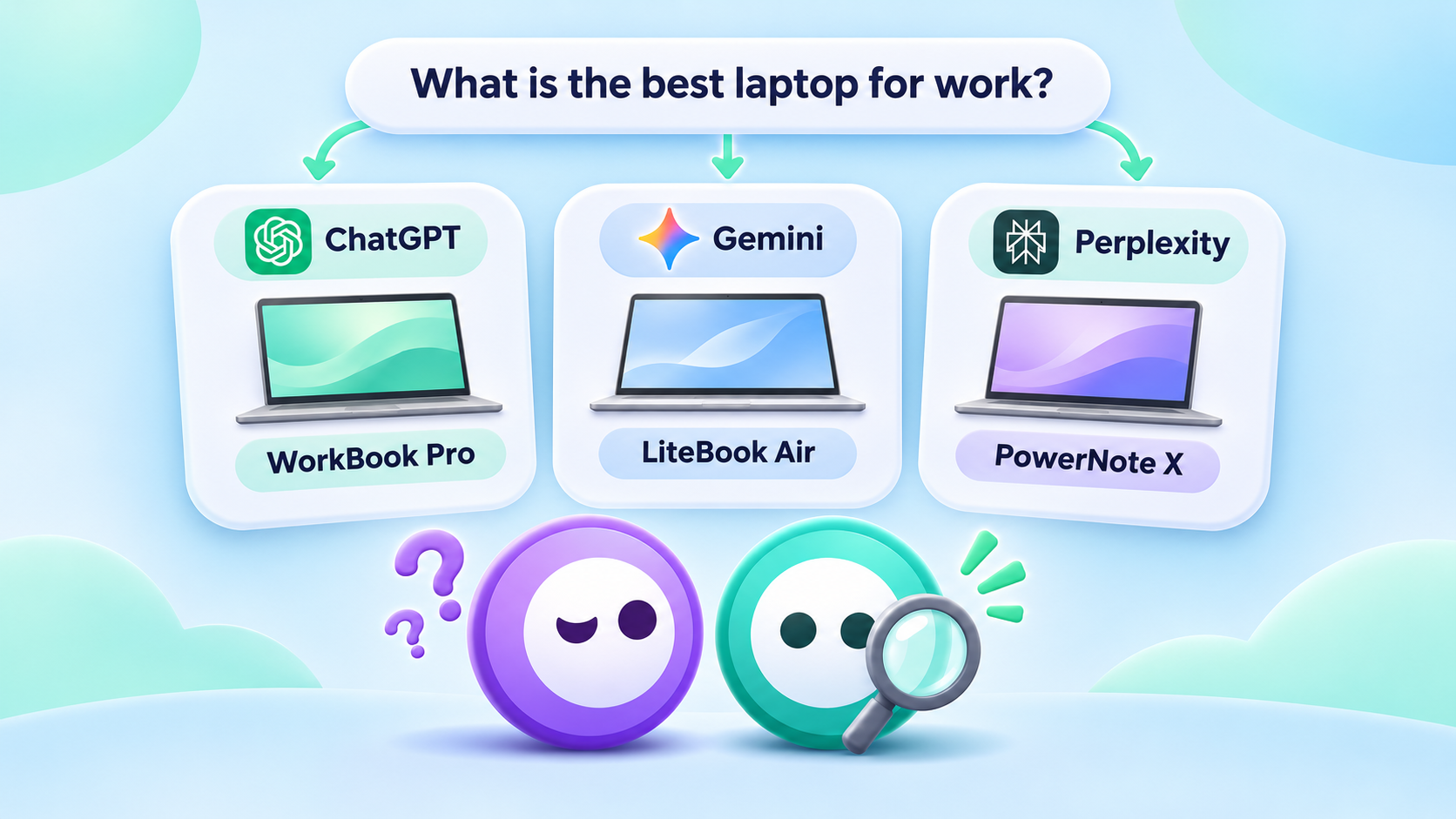
keenOly runs live browser sessions at the moment of each scan, bypassing stale API caches to capture the AI search experience as it appears during that run. You can see the exact competitor recommendations that were observed, along with the context around them.

This matters because an AI search experience can contain much more than a written answer.

Product cards, advertisements, images, videos and local business recommendations can all be part of the experience. A text-only measurement approach risks overlooking those additional opportunities for brand discovery. keenOly captures supported visual and commercial elements during live scans, rather than just analyzing the written response.

keenOly tracks six AI engines:

  • ChatGPT

  • Google AI Mode

  • Google AI Overviews

  • Google Gemini

  • Bing AI Mode

  • Perplexity

Each engine is analyzed separately. After all, being popular with Gemini doesn't necessarily mean Perplexity feels the same way about you.

On supported plans, keenOly actively tracks live ChatGPT ad visibility and sponsored product cards, so you can investigate both organic recommendations and paid placements when they appear. For a brand planning investment in AI advertising, seeing which competitors appear alongside relevant buyer questions can be particularly useful.

These scans represent observed answers under particular test conditions, rather than a record of every customer's personal AI conversation.

Three different questions deserve three different measurements

Here's where keenOly takes a different approach to the numbers. A brand mention is not necessarily a recommendation, and a recommendation isn't necessarily a competitive win.

Ask ChatGPT about your brand by name, and you've already introduced your business into the conversation.

Ask it to recommend the best products in your category without mentioning your brand, and you might get a very different answer.

keenOly separates these measurements instead of blending them into a single visibility score.

MetricWhat keenOly investigates
Discovery VisibilityDoes AI introduce your brand when buyers haven't mentioned it?
Branded PerceptionHow does AI describe and recommend your brand when asked about it?
Competitive Win RateDoes AI favor your brand when directly compared with competitors?

A business can perform exceptionally well in one area and struggle in another.

Combining them into an overall score could hide exactly the problem you're trying to find. By keeping the three measures separate, keenOly helps you pinpoint whether to improve category discovery, correct brand perception or strengthen your position against specific competitors.

We've explored this in more detail in our guide to choosing which AI search prompts to track.

Connecting Google search performance with AI visibility

There's a second blind spot Oly is rather keen to investigate: the gap between what traditional search rewards and what AI recommends.

By connecting Google Analytics 4 and Google Search Console, keenOly can bring together traditional search performance, website analytics and AI citation data.

Consider a product page receiving substantial organic search traffic but appearing in none of the relevant AI answers being monitored.

That's a potential commercial blind spot worth investigating.

Is the page missing information AI engines look for? Are competing websites explaining the product more clearly? Are third-party publications recommending another brand?

Oly can help investigate those questions using your tracked data.

You can investigate the gap using connected data rather than jumping between SEO reports, analytics dashboards and AI visibility tools. That makes it easier to prioritize pages and topics where a change could make a commercial difference.

It doesn't automatically quantify lost revenue, but it gives marketing teams a much more informed starting point.

Do more: Operational leverage with Agent Oly

Nobody particularly enjoys discovering another list of things they need to fix.

Especially when the list arrives on a Friday afternoon.

Agent Oly is built to turn findings into action. Rather than handing you a prettier to-do list, Oly identifies citation gaps, formulates semantic solutions and autonomously implements approved fixes directly in your connected CMS.

Within keenOly, Agent Oly can:

  • Investigate citation gaps and competitor appearances.

  • Identify content opportunities based on relevant buyer questions.

  • Investigate changes in visibility and the evidence behind them.

  • Formulate semantic solutions and develop content briefs that address the questions buyers are asking.

  • Write articles in your brand's voice.

  • Execute approved fixes directly in supported CMS infrastructure, including WordPress content drafting and scheduled publication.

Rather than handing over a list of recommendations and expecting another team to start from scratch, keenOly connects the investigation, content planning, writing and direct CMS remediation in one place.

Review the proposed fix, approve it with a click and let Agent Oly carry out the supported change. That's the practical value of autonomous, approval-based remediation: the work moves from recommendation to execution without your team having to manually implement every approved fix.

Your team retains control over what gets approved. Changes outside the scope of supported CMS workflows may still need specialist review, but routine supported remediation no longer has to become a separate manual project.

And after a fix? You can monitor what changes in your AI citations, Google search performance and website traffic.

Oly likes following up. The first answer is rarely the end of the investigation.

Sell more: Commercial enablement built for agencies

An AI visibility audit might reveal an excellent business opportunity.

But turning that audit into something a prospective client understands, values and is willing to pay for is another matter.

Someone has to interpret the data, build a presentation, explain the competitive gaps and propose a strategy.

That's time an agency could otherwise spend on client work or developing new business.

keenOly bridges that gap by instantly generating boardroom-ready, white label PowerPoint (PPTX) pitch decks, complete with prewritten speaker notes. Instead of assigning someone to build a presentation from scratch, your agency can generate an editable deck from its monitoring data and focus on the strategy and the conversation.

These presentations can explain:

  • Where a brand appears in AI recommendations.

  • Which competitors are getting recommended instead.

  • How visibility differs across engines.

  • Where traditional search and AI visibility diverge.

  • Which improvements deserve attention.

  • What the next steps should be.

Agencies can also manage multiple client projects and share reports under their own branding.

For agencies preparing high-value, white label GEO Strategy Audits, that means a client-ready pitch deck can be generated without allocating separate resources to building the presentation from scratch. Tailor it to the client, explain the opportunity and use it to pitch an audit, an optimization project or an ongoing GEO retainer. The deck is ready to support the sales conversation; winning the engagement is still up to the agency.

That's an important distinction. keenOly isn't just designed to help agencies deliver GEO services. It's designed to help them sell those services, too.

Enterprise-minded capabilities from $49 a month

You don't need to start with an enterprise quote to explore keenOly's core workflow. Every paid plan includes all six engines, unlimited projects, prompts and competitors, scheduled monitoring, unlimited Oly conversations, GA4 and Search Console, technical and content audits, WordPress content workflows and an executive briefing deck. Actual monitoring volume and content output are subject to the plan's allowances.

Lite ($49/month) includes 2,500 monthly credits and five Oly-written posts. Growth ($149/month) includes 10,000 credits and ten posts, while Elite ($299/month) includes 25,000 credits and twenty posts. That gives an agency room to start with its own brand, add client projects and expand usage as the business grows. (keenOly plans).

Pros

  • Live browser sessions at the moment of scanning, bypassing stale API caches.

  • Separate visibility, perception and competitive performance metrics.

  • Monitoring across six AI engines.

  • Live ChatGPT ad visibility and sponsored product card monitoring on supported plans.

  • Google Analytics 4 and Search Console integrations.

  • Autonomous Agent Oly: citation gap identification, semantic solutions and one-click approval for direct CMS remediation.

  • Instant, editable white label PPTX pitch decks with prewritten speaker notes.

  • Agency commercial enablement for pitching high-value GEO Strategy Audits, with multi-client projects and branded reporting.

  • Monitoring changes after optimization work.

  • Access to all six engines, executive briefing decks and core integrations from the $49 paid plan, subject to usage allowances.

Limitations

keenOly is not a replacement for every traditional SEO function. Teams that rely heavily on extensive historical backlink databases and conventional keyword research may still need dedicated SEO software.

Its greatest value comes from a structural change in how teams work. Passive dashboard reporting is no longer enough when the goal is to improve AI visibility. keenOly asks teams to move from reporting metrics to approving, executing and measuring improvements. If you only want another monthly dashboard, you may not take full advantage of Agent Oly.

Our assessment: We'd put keenOly first on the shortlist for brands and agencies that want to move from AI visibility to action. Live scanning, separate buyer-intent metrics, the Search vs. AI blind spot, autonomous CMS remediation and instant white label pitch decks come together in one platform, starting at a transparent entry price.

AI visibility monitoring tools: Feature comparison

CapabilitykeenOlyProfoundPeec AIOtterlyAIAhrefs Brand RadarPromptwatch
Multi-engine monitoringYesYesYesYesYesYes
Sentiment analysisYesYesYesYesYesYes
Competitor and citation analysisYesYesYesYesYesYes
Browser-based collectionLive browser scansYesWeb UI (ChatGPT documented)Web UIWeb UI; API exceptionsYes
ChatGPT advertising and shoppingLive ads; sponsored cardsShopping; ad campaign dataShopping analyticsAds and shoppingNot confirmedPlan dependent
GA4 integrationYesYesYesExternal reportingCheck availabilityCheck availability
Search Console integrationYesYesYesExternal reportingVia AhrefsYes
Agent-driven CMS publishingAutonomous; approval-basedYesConnector dependentNot confirmedNot confirmedPlan dependent
Executive PPTX with speaker notesInstant white label PPTXNot confirmedNot confirmedNot confirmedNot confirmedNot confirmed
Agency sales workflowWhite label pitch decksAgency pitch workspacesAgency reporting and pitch projectsAgency partner programReporting toolsPitch projects

Not confirmed or check availability means the specific capability was not established in the public documentation reviewed; it does not mean a platform lacks it. Web UI collection describes documented methods, not a guarantee that every engine or feature uses the same method. Features may depend on the subscription or integration. Ad campaign data, observed ads and organic shopping cards are different types of intelligence.

Collection and integration references: Profound, Peec AI, OtterlyAI, Ahrefs, Promptwatch.

How much do AI visibility monitoring tools cost in 2026?

The monthly subscription is only part of the decision. Some platforms charge by AI engine, prompt checks, workspace or agent credits, while others bundle more capabilities at the entry tier. Here's a snapshot of advertised prices for brands and agency options where published.

PlatformBrand pricing (USD/month)Agency or other pricing
keenOlyFree scan; Lite $49; Growth $149; Elite $299Same paid tiers; unlimited projects, subject to credits
ProfoundFree trial; custom EnterpriseAgency Growth and custom terms; confirm quote
Peec AIStarter $95; Pro $245; Advanced $495Agency credit packages from $245 to $1,195 (agency pricing)
OtterlyAILite $29; Standard $189; Premium $489Agency Partner via Standard or Premium; custom Enterprise
Ahrefs Brand RadarCustom prompts from $50; single AI index $199; all-platform access $699Custom prompt Growth $100; Scale $250; standalone options
PromptwatchEssential $95; Professional $245; Business $579Kick-off $199; Growth $399; Scale $799

Prices checked November 18, 2026 against public vendor materials. Profound's newer pricing lists a trial and custom Enterprise terms; older cached pages still show self-serve plans. Confirm live quotes, agency terms and usage allowances before buying. These plans are not like-for-like; additional engines, credits, seats, add-ons or taxes may affect the cost.

How to choose the best AI visibility monitoring tool for your business

Rather than comparing platforms by the sheer number of features they offer, we'd suggest asking five questions.

1. How is the data collected?

Does the platform observe AI browser experiences, query model APIs or use a historical dataset? Can it capture advertisements, product cards and other elements beyond text?

2. Does it measure the questions that matter to your buyers?

Look for meaningful distinctions between discovery, branded perception and competitive comparisons.

3. Can you connect the results to your existing marketing data?

AI visibility becomes more useful when you can examine it alongside search performance, website visits and conversions.

4. What happens after you identify a problem?

Can the platform only generate recommendations, or does it also help create and implement approved content improvements?

5. Can you communicate the value to other people?

For agencies and enterprise marketers, presenting a clear strategy to clients and senior stakeholders matters just as much as collecting the data.

A platform doesn't necessarily need to do everything. It needs to do the things your team will actually use. Compare the cost of that complete workflow, not just the cheapest advertised subscription.

Why digital marketing agencies need more than AI visibility reports

There's a commercial opportunity here that agencies shouldn't overlook.

Clients are beginning to ask whether their businesses appear in ChatGPT. Before long, more of them will want to know what competitors AI recommends, why their own brand is missing and what their agency intends to do about it.

An AI visibility report can start that conversation. A GEO strategy audit can turn it into a service, and an executive-ready pitch can help your agency win the work in the first place.

Agencies that connect competitive research, actionable recommendations, content execution and client presentations are better positioned to build recurring GEO engagements.

With keenOly's instant white label PPTX pitch decks, speaker notes and branded reports, agencies can go into a client conversation without dedicating separate resources to building every presentation from scratch. That's more time for pitching, delivering and following up on high-value GEO engagements.

That's why we think the next generation of AI visibility platforms needs to be designed around commercial outcomes as well as analytics.

After all, a client doesn't necessarily want another dashboard.

They want to understand where their business is losing opportunities and how their agency plans to help.

Knowing where you're losing is only half the job

The AI visibility market has come a long way in a relatively short time.

Monitoring brand mentions was once a differentiator. Now, more platforms are introducing agents, content optimization and workflows that help businesses act on those findings.

That's a welcome development.

It also changes what marketers should expect when investing in GEO software.

The question is no longer simply which platform can tell you that a competitor is winning.

It's which platform can help you understand why, work out what needs to change, make those improvements and communicate the results to the people who matter.

That's what we've built with keenOly: see more of the live AI search experience, do more with Agent Oly's direct CMS execution and sell more GEO services with white label pitch decks you can take straight into a client conversation. If that sounds like the workflow you're looking for, start with keenOly and see how it fits your business.

And Oly would be rather curious to find out what opportunities your brand might be missing. ๐Ÿ’š

Let Oly take a look.

Your first 10 ChatGPT prompts are free, along with 10 questions to Oly. No credit card required.

Frequently asked questions about AI visibility monitoring tools

What are the best AI visibility monitoring tools in 2026?

Six platforms worth comparing are keenOly, Profound, Peec AI, OtterlyAI, Ahrefs Brand Radar and Promptwatch. We'd start with keenOly if you want six-engine monitoring, search and analytics integration, autonomous approval-based CMS remediation and white label executive presentations in one platform, with paid plans starting at $49 a month. Other platforms may be better suited to specialist research or enterprise workflow requirements.

What is the best AI visibility monitoring tool for digital marketing agencies?

keenOly is a strong first choice for agencies that want to monitor multiple clients, investigate competitive gaps, execute approved CMS fixes and pitch high-value GEO services using instant white label PowerPoint decks with prewritten speaker notes. Its paid plans start at $49 a month and support unlimited projects subject to credit allowances. Promptwatch, Peec AI and other platforms also offer agency capabilities.

Are there GEO tools that automatically optimize website content?

Yes. keenOly's Agent Oly identifies citation gaps, formulates semantic solutions and autonomously implements approved fixes in supported CMS infrastructure. Profound, Peec AI and Promptwatch also offer content or agent-driven workflows that can connect to supported publishing systems. The level of automation, CMS compatibility and approval requirements vary.

Can AI visibility monitoring tools track ChatGPT ads and shopping recommendations?

Some can. keenOly and OtterlyAI, for example, offer monitoring of ChatGPT advertising and shopping experiences. It's important to distinguish observing advertisements and product placements from accessing an advertiser's own campaign performance data.

What is the cheapest AI visibility monitoring tool?

Among the ongoing paid brand subscriptions in this comparison, OtterlyAI Lite starts at $29 a month and keenOly Lite at $49. Ahrefs offers custom prompt packages from $50. Compare engine access, usage limits, integrations and agent workflows before deciding which platform represents the best value for your team.

Do AI visibility tools replace Google Search Console?

No. Google Search Console remains valuable for understanding your website's performance in Google Search. AI visibility platforms complement that information by examining brand recommendations, competitor appearances and sources across additional AI environments.

Can I monitor my brand's AI visibility for free?

Yes. keenOly offers a free AI visibility scan that includes 10 ChatGPT prompts and 10 questions to Oly. It's a useful way to begin investigating your brand's presence before investing in ongoing monitoring.
6 Best AI Visibility Monitoring Tools for Brands and Agencies in 2026

Not all AI visibility tools are built to do the same job. Compare six leading GEO platforms, their pricing, features and automation capabilities, and discover which tools help brands and agencies go beyond monitoring and turn AI search intelligence into action.

Ranking first on Google used to be a pretty good reason to celebrate.

It still is. But there are now buying conversations happening elsewhere, and your SEO reports might not be telling you much about them.

In September 2026, NielsenIQ reported that 51% of US consumers had used AI to assist with shopping in the previous month.

People are asking ChatGPT, Gemini and Perplexity which products to buy, which companies to work with and which brands to trust. And unlike a traditional search results page, an AI answer can narrow the options down to a handful of recommendations.

Lovely if you're one of them. Less lovely if you're not.

For brands, this creates a competitive blind spot: missed recommendations can mean missed commercial opportunities, even while search rankings look healthy. For agencies, it introduces another challenge: how do you demonstrate value, protect client retainers and grow new GEO services when traditional SEO metrics no longer tell the whole story?

It's one reason Generative Engine Optimization (GEO) and Answer Engine Optimization (AEO) are becoming increasingly important parts of digital marketing.

We've compared six of the best AI visibility monitoring tools in 2026, looking at how they collect data, what they measure, how much they cost and, perhaps most importantly, what they help you do next. Our starting point is simple: a GEO platform should help you see more, do more and, if you're an agency, sell more.

Because Oly has never been particularly satisfied with knowing there's a problem and leaving it at that. ๐Ÿ’š

What are AI visibility monitoring tools?

AI visibility monitoring tools measure how often, where and in what context brands appear in AI-generated answers across platforms such as ChatGPT, Gemini, Perplexity and Google AI search.

Depending on the platform, they can help you monitor:

  • Brand mentions and recommendations

  • AI share of voice and competitor performance

  • Brand sentiment and perception

  • Sources and citations influencing AI answers

  • AI search prompts and related queries

  • Advertising and product recommendations

  • Website traffic originating from AI platforms

  • Content and technical optimization opportunities

Traditional SEO tools remain valuable. In fact, Google introduced dedicated generative AI performance reports in Search Console in June 2026.

But knowing how your website performs in Google doesn't necessarily tell you which competitors ChatGPT recommends or why Gemini keeps citing someone else's content.

A growing number of GEO platforms are also moving beyond measurement, introducing AI agents that help investigate problems, create content and implement improvements.

That distinction between monitoring and execution is worth paying attention to when choosing a platform.

The 6 best AI visibility monitoring tools in 2026: At a glance

PlatformPrimary strengthBest suited to
keenOlyAI visibility, agentic execution and agency sales enablementBrands and agencies looking to turn insights into action
ProfoundEnterprise AI intelligence and workflow automationLarge marketing and content operations teams
Peec AIAccessible AI visibility analyticsMarketers who prioritize clear reporting
OtterlyAIAI search monitoring and GEO auditsBusinesses establishing a GEO strategy
Ahrefs Brand RadarLarge-scale SEO and AI visibility researchEstablished SEO teams
PromptwatchGranular prompt analysis and content optimizationSpecialist GEO teams

If you want to see live AI search experiences, connect competitive visibility with search and traffic data, let an agent implement approved CMS fixes and generate white label client pitches, we'd start with keenOly. Its paid plans begin at $49 a month and include access to all six engines, GA4, Search Console, Oly and executive briefing decks, subject to plan allowances. You can also try a free scan before paying.

But different teams have different priorities, so let's look at where each platform fits.

Editorial disclosure: This comparison is published by keenOly, which is one of the platforms featured. Competitor assessments are based on publicly available product information and our interpretation of each platform's positioning as of November 18, 2026, rather than independent hands-on testing of all six products. keenOly's capabilities are described using our own product information. Features and availability may vary by subscription. Prices are in US dollars on monthly billing unless noted.

1. Profound: Best for enterprise AI visibility intelligence

Profound has established itself as a prominent enterprise-focused AI search intelligence platform.

It's designed for marketing teams that need to understand brand perception at scale, analyze large amounts of AI visibility data and bring those findings into broader marketing operations.

Pros

  • Enterprise-scale brand sentiment and competitive intelligence.

  • Detailed analysis of AI mentions, citations and recommendations.

  • Data exports and automated workflows suitable for large research and content operations.

  • Browser-based AI answer collection.

  • Google Analytics 4 and Google Search Console integrations, including page-level search performance and AI citation comparisons.

  • AI agents that can generate content and publish it through connected CMS platforms.

Profound's Agents extend its capabilities beyond reporting, allowing teams to build workflows around their visibility data.

Limitations

Profound's extensive workflow capabilities may require more configuration and operational planning than a smaller marketing team wants to undertake.

Profound captures answers from the consumer web interface, not simply from model APIs. Its breadth is an advantage; buyers should still check which engines, visual answer elements and workflows are available on their chosen plan. (data methodology).

Profound offers ChatGPT shopping intelligence on Enterprise and advertising integrations, including OpenAI Ads performance data. However, buyers should distinguish between accessing their own advertising campaign data and observing which competitor ads actually appear alongside specific AI answers. (OpenAI Ads integration).

It's also worth asking how quickly newly introduced interface features and visual recommendations become available for monitoring.

Our assessment: Profound deserves consideration for enterprise teams with extensive intelligence requirements and the resources to build sophisticated marketing workflows. Its latest advertised brand offering is a free trial followed by custom Enterprise pricing, so teams that prefer a transparent starting subscription should compare alternatives. (pricing).

2. Peec AI: Best for accessible AI visibility reporting

Peec AI makes AI search performance relatively easy to understand, particularly for marketing teams that don't want to spend their afternoons explaining complicated dashboards.

Its approach centers on visibility, sentiment, position, share of voice and the sources influencing AI recommendations.

Pros

  • An accessible, visually intuitive reporting experience.

  • Competitive AI share of voice benchmarking.

  • Brand sentiment and position tracking.

  • Source analysis and content improvement recommendations.

  • Google Analytics 4 and Google Search Console integrations, including page-level Google search versus AI citation gap analysis.

  • Agency reporting and pitch projects for prospective clients.

Peec AI has also introduced Peec Agent and Actions, expanding its offering into connected marketing workflows and content publishing.

Limitations

Although Peec AI has moved beyond passive reporting, the extent of automation depends on which integrations are connected and what actions those integrations support.

For teams seeking an end-to-end GEO execution process, it's worth examining how much work happens within the platform and how much still requires coordination across external systems.

Its analytics integrations also help identify pages that rank in Google but are rarely cited by AI, and vice versa. That provides useful commercial context, but no platform can conclusively attribute every lost purchase to a competitor's AI recommendation.

Our assessment: Peec AI is a strong option if accessible reporting and stakeholder communication are priorities. Teams looking for extensive remediation and agency sales workflows should compare those capabilities separately.

3. OtterlyAI: Best for AI search monitoring and GEO audits

OtterlyAI is particularly relevant for businesses beginning to establish their AI search performance baseline.

It gives marketing teams a practical way to monitor AI answers, assess website readiness and uncover opportunities for improvement.

Pros

  • Seven AI search platforms available on all plans, including ChatGPT, Perplexity and Google AI Overviews. Engine selection and usage are subject to workspace and credit allowances.

  • Automated GEO audits covering technical and content issues.

  • Content briefs and optimization recommendations.

  • ChatGPT advertising and shopping tracking on all plans.

  • AI crawler and visitor analytics.

Its GEO features make it useful for initial research, website audits and conversations with clients who are new to AI search optimization.

Limitations

Identifying a content or technical issue isn't necessarily the same as resolving it.

OtterlyAI offers optimization guidance and content briefs, but buyers seeking autonomous, approval-based CMS remediation should investigate how far its current implementation capabilities extend.

It collects responses through public AI web interfaces and offers analytics and external reporting integrations, including Looker Studio, where AI visibility data can be combined with traditional search and website analytics. (collection methodology).

For agencies, the question is how easily those datasets can be connected to identify individual pages that perform well in Google but remain absent from commercially important AI answers. Its credit-based engine allowances are also worth checking when planning coverage across all seven platforms.

Our assessment: OtterlyAI is a useful choice for monitoring, GEO audits and establishing a baseline before committing to a wider optimization program.

4. Ahrefs Brand Radar: Best for established SEO teams

Ahrefs Brand Radar brings AI visibility research into one of the most established SEO ecosystems.

For teams already using Ahrefs for keyword research, backlinks and competitive intelligence, that familiarity is a considerable advantage.

Pros

  • A large database of search-backed AI prompts.

  • AI visibility research across multiple platforms, including Google AI Overviews and AI Mode.

  • Brand mentions, citations, sentiment and share of voice.

  • Custom conversational prompt tracking.

  • Related search query analysis and broader online brand research.

Ahrefs explains its approach in its Brand Radar methodology, which combines search behavior with broader topic coverage.

Limitations

Ahrefs' historical search data is one of its greatest strengths, but conventional keyword demand and conversational AI intent aren't necessarily the same thing.

A keyword such as "best running shoes" doesn't capture the specific requirements of someone asking ChatGPT for affordable running shoes suitable for wide feet and marathon training.

Ahrefs addresses this through custom prompts, although teams still need to decide which questions represent their most commercially important buyers.

Brand Radar's principal strength is research and analysis. Its indexed chatbot answers are collected through web interfaces, with some exceptions, and historical indexes refresh separately from custom prompt checks. Businesses wanting an agent to investigate a specific citation gap and implement an approved content change should evaluate the wider Ahrefs execution workflows separately. (Brand Radar documentation).

Our assessment: Ahrefs Brand Radar makes particular sense for SEO teams that want to expand their existing research capabilities into AI visibility.

5. Promptwatch: Best for granular AI prompt and content analysis

Promptwatch takes a detailed approach to understanding AI answers, the sources behind them and the content opportunities they reveal.

It's useful for businesses that want to examine specific questions closely, particularly where technical requirements or subtle differences in AI responses matter.

Pros

  • Granular monitoring of AI prompts and responses.

  • Citation, content gap and competitor analysis.

  • AI crawler and website visitor analytics.

  • Content agents and publishing integrations.

  • Dedicated enterprise and agency offerings.

Promptwatch has developed considerably beyond its original monitoring capabilities, with agent-driven optimization and CMS publishing available on qualifying plans.

Limitations

The platform's capabilities vary between brand and agency subscriptions.

For example, its published plan information distinguishes agency monitoring and pitch projects from certain content creation and automated optimization features available on brand plans.

Agencies should therefore examine which features are included in their chosen subscription, particularly if they intend to monitor several clients and execute content improvements for each of them.

Its reporting and pitch project capabilities are useful, although agencies looking specifically for editable, white label PowerPoint presentations with prewritten speaker notes should confirm whether those deliverables are available in their required format.

Our assessment: Promptwatch is worth considering for specialist GEO teams that value detailed prompt intelligence and content optimization. Check the subscription structure carefully if you intend to use it across multiple clients.

6. keenOly: Best for brands and agencies that want to see more, do more and sell more

Naturally, we've been rather keen to get to this one.

keenOly was built around a question that marketing teams eventually arrive at after looking through their AI visibility reports.

What do we actually do about all this?

Knowing that your competitors are appearing in AI recommendations is useful. But what if the same platform could help you find the gaps in your traditional search strategy, work out what to change, implement the fixes in your CMS and generate the presentation for your next client pitch?

That's the thinking behind keenOly, built specifically for enterprise marketing teams and digital agencies that need more than a reporting dashboard. Three priorities shape the platform: see more of the AI search experience, do more with Agent Oly and help agencies sell more GEO services.

See more: Data superiority that goes beyond the written answer

AI answers aren't static search listings. They can change depending on the question, engine, market and timing.

keenOly runs live browser sessions at the moment of each scan, bypassing stale API caches to capture the AI search experience as it appears during that run. You can see the exact competitor recommendations that were observed, along with the context around them.

This matters because an AI search experience can contain much more than a written answer.

Product cards, advertisements, images, videos and local business recommendations can all be part of the experience. A text-only measurement approach risks overlooking those additional opportunities for brand discovery. keenOly captures supported visual and commercial elements during live scans, rather than just analyzing the written response.

keenOly tracks six AI engines:

  • ChatGPT

  • Google AI Mode

  • Google AI Overviews

  • Google Gemini

  • Bing AI Mode

  • Perplexity

Each engine is analyzed separately. After all, being popular with Gemini doesn't necessarily mean Perplexity feels the same way about you.

On supported plans, keenOly actively tracks live ChatGPT ad visibility and sponsored product cards, so you can investigate both organic recommendations and paid placements when they appear. For a brand planning investment in AI advertising, seeing which competitors appear alongside relevant buyer questions can be particularly useful.

These scans represent observed answers under particular test conditions, rather than a record of every customer's personal AI conversation.

Three different questions deserve three different measurements

Here's where keenOly takes a different approach to the numbers. A brand mention is not necessarily a recommendation, and a recommendation isn't necessarily a competitive win.

Ask ChatGPT about your brand by name, and you've already introduced your business into the conversation.

Ask it to recommend the best products in your category without mentioning your brand, and you might get a very different answer.

keenOly separates these measurements instead of blending them into a single visibility score.

MetricWhat keenOly investigates
Discovery VisibilityDoes AI introduce your brand when buyers haven't mentioned it?
Branded PerceptionHow does AI describe and recommend your brand when asked about it?
Competitive Win RateDoes AI favor your brand when directly compared with competitors?

A business can perform exceptionally well in one area and struggle in another.

Combining them into an overall score could hide exactly the problem you're trying to find. By keeping the three measures separate, keenOly helps you pinpoint whether to improve category discovery, correct brand perception or strengthen your position against specific competitors.

We've explored this in more detail in our guide to choosing which AI search prompts to track.

Connecting Google search performance with AI visibility

There's a second blind spot Oly is rather keen to investigate: the gap between what traditional search rewards and what AI recommends.

By connecting Google Analytics 4 and Google Search Console, keenOly can bring together traditional search performance, website analytics and AI citation data.

Consider a product page receiving substantial organic search traffic but appearing in none of the relevant AI answers being monitored.

That's a potential commercial blind spot worth investigating.

Is the page missing information AI engines look for? Are competing websites explaining the product more clearly? Are third-party publications recommending another brand?

Oly can help investigate those questions using your tracked data.

You can investigate the gap using connected data rather than jumping between SEO reports, analytics dashboards and AI visibility tools. That makes it easier to prioritize pages and topics where a change could make a commercial difference.

It doesn't automatically quantify lost revenue, but it gives marketing teams a much more informed starting point.

Do more: Operational leverage with Agent Oly

Nobody particularly enjoys discovering another list of things they need to fix.

Especially when the list arrives on a Friday afternoon.

Agent Oly is built to turn findings into action. Rather than handing you a prettier to-do list, Oly identifies citation gaps, formulates semantic solutions and autonomously implements approved fixes directly in your connected CMS.

Within keenOly, Agent Oly can:

  • Investigate citation gaps and competitor appearances.

  • Identify content opportunities based on relevant buyer questions.

  • Investigate changes in visibility and the evidence behind them.

  • Formulate semantic solutions and develop content briefs that address the questions buyers are asking.

  • Write articles in your brand's voice.

  • Execute approved fixes directly in supported CMS infrastructure, including WordPress content drafting and scheduled publication.

Rather than handing over a list of recommendations and expecting another team to start from scratch, keenOly connects the investigation, content planning, writing and direct CMS remediation in one place.

Review the proposed fix, approve it with a click and let Agent Oly carry out the supported change. That's the practical value of autonomous, approval-based remediation: the work moves from recommendation to execution without your team having to manually implement every approved fix.

Your team retains control over what gets approved. Changes outside the scope of supported CMS workflows may still need specialist review, but routine supported remediation no longer has to become a separate manual project.

And after a fix? You can monitor what changes in your AI citations, Google search performance and website traffic.

Oly likes following up. The first answer is rarely the end of the investigation.

Sell more: Commercial enablement built for agencies

An AI visibility audit might reveal an excellent business opportunity.

But turning that audit into something a prospective client understands, values and is willing to pay for is another matter.

Someone has to interpret the data, build a presentation, explain the competitive gaps and propose a strategy.

That's time an agency could otherwise spend on client work or developing new business.

keenOly bridges that gap by instantly generating boardroom-ready, white label PowerPoint (PPTX) pitch decks, complete with prewritten speaker notes. Instead of assigning someone to build a presentation from scratch, your agency can generate an editable deck from its monitoring data and focus on the strategy and the conversation.

These presentations can explain:

  • Where a brand appears in AI recommendations.

  • Which competitors are getting recommended instead.

  • How visibility differs across engines.

  • Where traditional search and AI visibility diverge.

  • Which improvements deserve attention.

  • What the next steps should be.

Agencies can also manage multiple client projects and share reports under their own branding.

For agencies preparing high-value, white label GEO Strategy Audits, that means a client-ready pitch deck can be generated without allocating separate resources to building the presentation from scratch. Tailor it to the client, explain the opportunity and use it to pitch an audit, an optimization project or an ongoing GEO retainer. The deck is ready to support the sales conversation; winning the engagement is still up to the agency.

That's an important distinction. keenOly isn't just designed to help agencies deliver GEO services. It's designed to help them sell those services, too.

Enterprise-minded capabilities from $49 a month

You don't need to start with an enterprise quote to explore keenOly's core workflow. Every paid plan includes all six engines, unlimited projects, prompts and competitors, scheduled monitoring, unlimited Oly conversations, GA4 and Search Console, technical and content audits, WordPress content workflows and an executive briefing deck. Actual monitoring volume and content output are subject to the plan's allowances.

Lite ($49/month) includes 2,500 monthly credits and five Oly-written posts. Growth ($149/month) includes 10,000 credits and ten posts, while Elite ($299/month) includes 25,000 credits and twenty posts. That gives an agency room to start with its own brand, add client projects and expand usage as the business grows. (keenOly plans).

Pros

  • Live browser sessions at the moment of scanning, bypassing stale API caches.

  • Separate visibility, perception and competitive performance metrics.

  • Monitoring across six AI engines.

  • Live ChatGPT ad visibility and sponsored product card monitoring on supported plans.

  • Google Analytics 4 and Search Console integrations.

  • Autonomous Agent Oly: citation gap identification, semantic solutions and one-click approval for direct CMS remediation.

  • Instant, editable white label PPTX pitch decks with prewritten speaker notes.

  • Agency commercial enablement for pitching high-value GEO Strategy Audits, with multi-client projects and branded reporting.

  • Monitoring changes after optimization work.

  • Access to all six engines, executive briefing decks and core integrations from the $49 paid plan, subject to usage allowances.

Limitations

keenOly is not a replacement for every traditional SEO function. Teams that rely heavily on extensive historical backlink databases and conventional keyword research may still need dedicated SEO software.

Its greatest value comes from a structural change in how teams work. Passive dashboard reporting is no longer enough when the goal is to improve AI visibility. keenOly asks teams to move from reporting metrics to approving, executing and measuring improvements. If you only want another monthly dashboard, you may not take full advantage of Agent Oly.

Our assessment: We'd put keenOly first on the shortlist for brands and agencies that want to move from AI visibility to action. Live scanning, separate buyer-intent metrics, the Search vs. AI blind spot, autonomous CMS remediation and instant white label pitch decks come together in one platform, starting at a transparent entry price.

AI visibility monitoring tools: Feature comparison

CapabilitykeenOlyProfoundPeec AIOtterlyAIAhrefs Brand RadarPromptwatch
Multi-engine monitoringYesYesYesYesYesYes
Sentiment analysisYesYesYesYesYesYes
Competitor and citation analysisYesYesYesYesYesYes
Browser-based collectionLive browser scansYesWeb UI (ChatGPT documented)Web UIWeb UI; API exceptionsYes
ChatGPT advertising and shoppingLive ads; sponsored cardsShopping; ad campaign dataShopping analyticsAds and shoppingNot confirmedPlan dependent
GA4 integrationYesYesYesExternal reportingCheck availabilityCheck availability
Search Console integrationYesYesYesExternal reportingVia AhrefsYes
Agent-driven CMS publishingAutonomous; approval-basedYesConnector dependentNot confirmedNot confirmedPlan dependent
Executive PPTX with speaker notesInstant white label PPTXNot confirmedNot confirmedNot confirmedNot confirmedNot confirmed
Agency sales workflowWhite label pitch decksAgency pitch workspacesAgency reporting and pitch projectsAgency partner programReporting toolsPitch projects

Not confirmed or check availability means the specific capability was not established in the public documentation reviewed; it does not mean a platform lacks it. Web UI collection describes documented methods, not a guarantee that every engine or feature uses the same method. Features may depend on the subscription or integration. Ad campaign data, observed ads and organic shopping cards are different types of intelligence.

Collection and integration references: Profound, Peec AI, OtterlyAI, Ahrefs, Promptwatch.

How much do AI visibility monitoring tools cost in 2026?

The monthly subscription is only part of the decision. Some platforms charge by AI engine, prompt checks, workspace or agent credits, while others bundle more capabilities at the entry tier. Here's a snapshot of advertised prices for brands and agency options where published.

PlatformBrand pricing (USD/month)Agency or other pricing
keenOlyFree scan; Lite $49; Growth $149; Elite $299Same paid tiers; unlimited projects, subject to credits
ProfoundFree trial; custom EnterpriseAgency Growth and custom terms; confirm quote
Peec AIStarter $95; Pro $245; Advanced $495Agency credit packages from $245 to $1,195 (agency pricing)
OtterlyAILite $29; Standard $189; Premium $489Agency Partner via Standard or Premium; custom Enterprise
Ahrefs Brand RadarCustom prompts from $50; single AI index $199; all-platform access $699Custom prompt Growth $100; Scale $250; standalone options
PromptwatchEssential $95; Professional $245; Business $579Kick-off $199; Growth $399; Scale $799

Prices checked November 18, 2026 against public vendor materials. Profound's newer pricing lists a trial and custom Enterprise terms; older cached pages still show self-serve plans. Confirm live quotes, agency terms and usage allowances before buying. These plans are not like-for-like; additional engines, credits, seats, add-ons or taxes may affect the cost.

How to choose the best AI visibility monitoring tool for your business

Rather than comparing platforms by the sheer number of features they offer, we'd suggest asking five questions.

1. How is the data collected?

Does the platform observe AI browser experiences, query model APIs or use a historical dataset? Can it capture advertisements, product cards and other elements beyond text?

2. Does it measure the questions that matter to your buyers?

Look for meaningful distinctions between discovery, branded perception and competitive comparisons.

3. Can you connect the results to your existing marketing data?

AI visibility becomes more useful when you can examine it alongside search performance, website visits and conversions.

4. What happens after you identify a problem?

Can the platform only generate recommendations, or does it also help create and implement approved content improvements?

5. Can you communicate the value to other people?

For agencies and enterprise marketers, presenting a clear strategy to clients and senior stakeholders matters just as much as collecting the data.

A platform doesn't necessarily need to do everything. It needs to do the things your team will actually use. Compare the cost of that complete workflow, not just the cheapest advertised subscription.

Why digital marketing agencies need more than AI visibility reports

There's a commercial opportunity here that agencies shouldn't overlook.

Clients are beginning to ask whether their businesses appear in ChatGPT. Before long, more of them will want to know what competitors AI recommends, why their own brand is missing and what their agency intends to do about it.

An AI visibility report can start that conversation. A GEO strategy audit can turn it into a service, and an executive-ready pitch can help your agency win the work in the first place.

Agencies that connect competitive research, actionable recommendations, content execution and client presentations are better positioned to build recurring GEO engagements.

With keenOly's instant white label PPTX pitch decks, speaker notes and branded reports, agencies can go into a client conversation without dedicating separate resources to building every presentation from scratch. That's more time for pitching, delivering and following up on high-value GEO engagements.

That's why we think the next generation of AI visibility platforms needs to be designed around commercial outcomes as well as analytics.

After all, a client doesn't necessarily want another dashboard.

They want to understand where their business is losing opportunities and how their agency plans to help.

Knowing where you're losing is only half the job

The AI visibility market has come a long way in a relatively short time.

Monitoring brand mentions was once a differentiator. Now, more platforms are introducing agents, content optimization and workflows that help businesses act on those findings.

That's a welcome development.

It also changes what marketers should expect when investing in GEO software.

The question is no longer simply which platform can tell you that a competitor is winning.

It's which platform can help you understand why, work out what needs to change, make those improvements and communicate the results to the people who matter.

That's what we've built with keenOly: see more of the live AI search experience, do more with Agent Oly's direct CMS execution and sell more GEO services with white label pitch decks you can take straight into a client conversation. If that sounds like the workflow you're looking for, start with keenOly and see how it fits your business.

And Oly would be rather curious to find out what opportunities your brand might be missing. ๐Ÿ’š

Let Oly take a look.

Your first 10 ChatGPT prompts are free, along with 10 questions to Oly. No credit card required.

Frequently asked questions about AI visibility monitoring tools

What are the best AI visibility monitoring tools in 2026?

Six platforms worth comparing are keenOly, Profound, Peec AI, OtterlyAI, Ahrefs Brand Radar and Promptwatch. We'd start with keenOly if you want six-engine monitoring, search and analytics integration, autonomous approval-based CMS remediation and white label executive presentations in one platform, with paid plans starting at $49 a month. Other platforms may be better suited to specialist research or enterprise workflow requirements.

What is the best AI visibility monitoring tool for digital marketing agencies?

keenOly is a strong first choice for agencies that want to monitor multiple clients, investigate competitive gaps, execute approved CMS fixes and pitch high-value GEO services using instant white label PowerPoint decks with prewritten speaker notes. Its paid plans start at $49 a month and support unlimited projects subject to credit allowances. Promptwatch, Peec AI and other platforms also offer agency capabilities.

Are there GEO tools that automatically optimize website content?

Yes. keenOly's Agent Oly identifies citation gaps, formulates semantic solutions and autonomously implements approved fixes in supported CMS infrastructure. Profound, Peec AI and Promptwatch also offer content or agent-driven workflows that can connect to supported publishing systems. The level of automation, CMS compatibility and approval requirements vary.

Can AI visibility monitoring tools track ChatGPT ads and shopping recommendations?

Some can. keenOly and OtterlyAI, for example, offer monitoring of ChatGPT advertising and shopping experiences. It's important to distinguish observing advertisements and product placements from accessing an advertiser's own campaign performance data.

What is the cheapest AI visibility monitoring tool?

Among the ongoing paid brand subscriptions in this comparison, OtterlyAI Lite starts at $29 a month and keenOly Lite at $49. Ahrefs offers custom prompt packages from $50. Compare engine access, usage limits, integrations and agent workflows before deciding which platform represents the best value for your team.

Do AI visibility tools replace Google Search Console?

No. Google Search Console remains valuable for understanding your website's performance in Google Search. AI visibility platforms complement that information by examining brand recommendations, competitor appearances and sources across additional AI environments.

Can I monitor my brand's AI visibility for free?

Yes. keenOly offers a free AI visibility scan that includes 10 ChatGPT prompts and 10 questions to Oly. It's a useful way to begin investigating your brand's presence before investing in ongoing monitoring.
Try keenOly

Start free at app.keenoly.com.